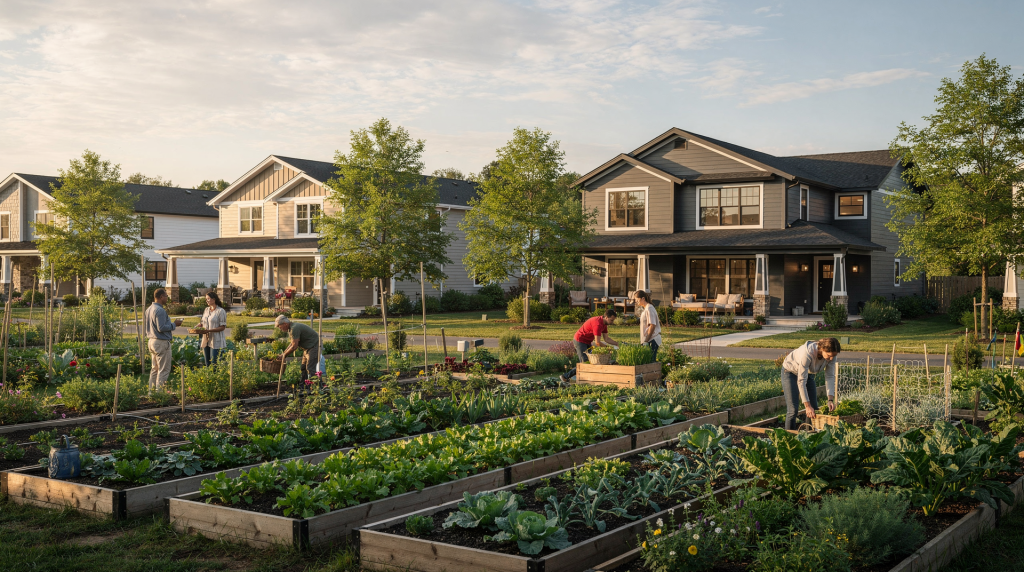
An agrihood is a neighborhood designed around a working farm or food-producing landscape — orchards, gardens, fields, greenhouse space. For the right buyer, it offers something increasingly rare: a daily life shaped by fresh food, open space, and a genuine connection to the land and the people around you. It’s a housing choice that treats the environment not as a backdrop, but as a daily contributor to your health, your stress levels, and your sense of belonging.
What an agrihood actually is
At its simplest, an agrihood blends agriculture and neighborhood into one living concept. Instead of a subdivision centered on a pool, golf course, or clubhouse, the farm or garden is the main amenity — often the organizing feature of the entire development. This isn’t a decorative afterthought. A true agrihood has a working agricultural component that produces food and meaningfully supports resident life. It’s a place where the rhythms of planting and harvest become part of your own weekly rhythm, whether you’re actively digging in the soil or simply picking up your CSA box.
Common agrihood features
| Feature | What it usually means |
|---|---|
| Working farm | Central food-producing land with crops, orchards, livestock, or a mix of all three |
| Community garden | Shared growing space for residents, often alongside the main farm |
| CSA or farm share | Residents receive regular produce from the community farm |
| Trails and open space | Walkable green areas designed to support outdoor living |
| Farm stand or market | On-site place to buy or pick up fresh food |
| Event and education space | Cooking classes, farm events, workshops, and gatherings |
Why agrihoods have become popular
Agrihoods appeal to buyers who want more than a house and a yard. They combine lifestyle, wellness, sustainability, and a sense of place in one package. The main draw is access to fresh food and outdoor living close to home. Many communities also emphasize social connection, since shared food systems and common spaces naturally create more interaction between neighbors. From a wellness perspective, this is powerful: the environment itself nudges you toward better daily choices — walking to pick up vegetables, talking with a neighbor over the herb beds, breathing air that hasn’t crossed a parking lot. It’s the same principle as keeping healthy food on the counter: make the good choice the easy choice.
Practical benefits buyers often care about
- Fresh produce is closer and easier to access.
- Outdoor activity becomes part of daily routines.
- Community events make it easier to meet neighbors.
- The setting often feels quieter, greener, and more intentional than a typical subdivision.
- Families may like the educational value for children.
Who an agrihood is right for
Agrihoods are not for everyone, but they are a strong fit for people who want their home to support a healthier, more connected lifestyle. If you’ve ever thought about how your living environment influences your energy, your food choices, or your stress levels — the way you’d think about a supplement or a meal plan — then an agrihood might align with your values.
Best fit for:
- Families who want children to grow up around nature, food, and outdoor activity.
- Wellness-focused buyers who value fresh food, walking, and open space.
- Empty nesters who want a quieter, lower-stress setting with built-in community.
- Remote workers who want a more nature-centered daily environment.
- Eco-minded buyers who care about land use, sustainability, and local food systems.
Usually not ideal for:
- Buyers who want total privacy and minimal neighbor interaction.
- People who prefer a highly urban lifestyle with quick access to dense retail and transit.
- Buyers who do not want ongoing community rules or shared-space expectations.
- Anyone looking for a low-maintenance “set it and forget it” home with no community involvement.
Agrihoods vs. traditional neighborhoods
| Category | Agrihood | Traditional neighborhood |
|---|---|---|
| Main amenity | Farm, garden, or food-producing land | Pool, clubhouse, golf course, or park |
| Daily lifestyle | More nature, food access, and shared activities | More private, property-focused living |
| Social feel | Often more communal and event-driven | Usually less structured social interaction |
| Sustainability focus | Often stronger emphasis on local food and land stewardship | Varies widely |
| Buyer motivation | Wellness, lifestyle, values, and community | Convenience, amenities, and housing type |
The real advantages of agrihood living
Agrihoods can support healthier routines in a very practical way. When fresh food, trails, gardens, and shared outdoor spaces are built into the neighborhood, good habits become easier to repeat. It’s a form of environmental design that works on your metabolism, your mood, and your social health without you having to think about it.
1. Better access to fresh food
Many agrihoods are designed around local food production, CSA programs, farm stands, or community-supported growing. That means residents may find it easier to buy or grow produce regularly without leaving the neighborhood. For anyone who has ever struggled to keep the fridge stocked with greens, this is a quiet game-changer. The food is often harvested at peak ripeness, which means more nutrients and better flavor — and less reliance on processed alternatives.
2. More movement without a gym mindset
Walking to a farm stand, garden, trail, or common area adds natural movement to the day. For many people, this is more sustainable than trying to force exercise into an already busy schedule. A ten-minute stroll to pick up eggs or herbs doesn’t feel like a workout, but over weeks and months, it adds up. It also helps regulate blood sugar and cortisol in a way that a rushed treadmill session rarely does.
3. Stronger sense of community
Shared gardens, harvest events, cooking classes, and farm programming create built-in reasons to interact. That can be especially valuable for families, newcomers, and people who feel isolated in conventional suburban settings. Social connection is one of the most underrated health interventions we have — it buffers stress, improves sleep, and even supports immune function. An agrihood bakes that connection into the neighborhood layout.
4. Better environmental alignment
Agrihoods often preserve open space, support food production, and reduce the sense of sprawling development. Some also emphasize regenerative practices, biodiversity, and lower transportation needs for food. Living in a place that aligns with your environmental values can reduce the low-grade cognitive dissonance many people feel in resource-heavy suburbs, and that peace of mind is part of wellness, too.
The limitations buyers should understand
Agrihood living sounds idyllic, but the model has tradeoffs. Knowing them upfront prevents disappointment later. Just as you wouldn’t take a supplement without understanding its side effects, you shouldn’t choose a home without weighing the less romantic realities.
Common drawbacks
- You may have less privacy than in a traditional neighborhood because of shared open space and community activity.
- Farm operations can bring noise, smells, equipment traffic, and seasonal activity — tractors at dawn, the earthy scent of compost, the crow of a rooster.
- HOA rules or community agreements may be more detailed than buyers expect, covering everything from fence heights to composting practices.
- Not every agrihood is equally committed to real agriculture; some are more branding than substance, with a few raised beds and a farm-themed logo.
- Homes may cost more because of the unique setting and demand from lifestyle buyers.
How to evaluate an agrihood before buying
A good agrihood should feel like a functioning community, not a marketing story. The key is to look closely at how the farm, homes, and resident experience actually work together. Walk the land at different times of day. Talk to people who live there. Ask yourself if the agricultural component is robust enough to sustain the lifestyle you’re imagining — and whether you’ll still love it when the novelty wears off.
Buyer checklist
- Is the farm operational, and who manages it?
- How much land is truly dedicated to food production versus decorative landscaping?
- Are residents allowed to participate, or is the farm mostly for show?
- What amenities are included besides the farm?
- Are there HOA rules, fees, or restrictions tied to the agricultural area?
- How noisy or busy is the community during planting and harvest seasons?
- Are there walking paths, gathering spaces, or food access points you would actually use?
- Does the community match your privacy, lifestyle, and long-term plans?
Questions to ask a developer or agent
Before committing, get specific answers to practical questions. These details often reveal whether the agrihood is a well-integrated living system or a conventional subdivision with a farm-themed veneer.
- What does the farm produce?
- Who pays for farm operations and maintenance?
- Is there a CSA, farm stand, or resident access program?
- How often are events held?
- Can residents garden themselves?
- Are there restrictions on pets, fencing, composting, or outdoor use?
- How are agricultural odors, pests, and equipment handled?
- What happens if the farm underperforms or changes management?
Is an agrihood a good investment?
Agrihoods often attract buyers willing to pay for lifestyle value, and some studies and industry sources note stronger appeal around green space, food access, and wellness-oriented living. That said, resale value depends on location, community management, and whether the farm component remains active and well maintained. The farm is not just a feature; it is part of the property’s identity. If the agricultural piece weakens — if the CSA stops, the fields go fallow, the barn becomes a storage unit — the whole value proposition can change. Buy with the understanding that you’re investing in a living system, not a static amenity.
Final thoughts
An agrihood is best understood as a home community built around food, land, and shared outdoor living. It is a strong fit for buyers who want healthier routines, more green space, and a deeper connection to where their food comes from. If you value privacy above all else, prefer a conventional suburban rhythm, or do not want to engage with community-driven amenities, an agrihood may feel like too much. But if you want your neighborhood to support a more intentional way of living — the way you’d choose a diet or a daily ritual — it is one of the most compelling housing models available today.
FAQ
What is the difference between an agrihood and a community garden?
An agrihood is a residential neighborhood built around a working farm or major food-producing space, while a community garden is usually just one amenity within a larger neighborhood. The scale and integration are fundamentally different: in an agrihood, the farm shapes the layout, the social life, and often the identity of the place.
Do all agrihoods have working farms?
Most do, but the quality and scale vary. Some have full farms with active production, while others lean more heavily on gardens, orchards, or smaller food-growing areas. It’s essential to visit and see how much food is actually being grown and whether it reaches residents’ tables.
Are agrihoods good for families?
Yes, especially for families who want outdoor time, food education, and a more active neighborhood setting. The fit is strongest when the community offers safe walkability, programming, and age-appropriate spaces. Children who grow up understanding where food comes from often develop healthier eating habits that last a lifetime.
Do agrihoods cost more than regular neighborhoods?
They can. Pricing depends on location, design quality, land value, and how desirable the lifestyle is in that market. The premium often reflects the preserved open space and the operational farm, but it’s worth weighing whether the long-term health and wellness benefits offset the upfront cost.
Can you live in an agrihood without farming?
Absolutely. Most residents are not full-time farmers; they simply live in a neighborhood where agriculture is part of everyday life. You can enjoy the fresh food, the walking trails, and the community events without ever picking up a trowel — though you might find yourself wanting to.