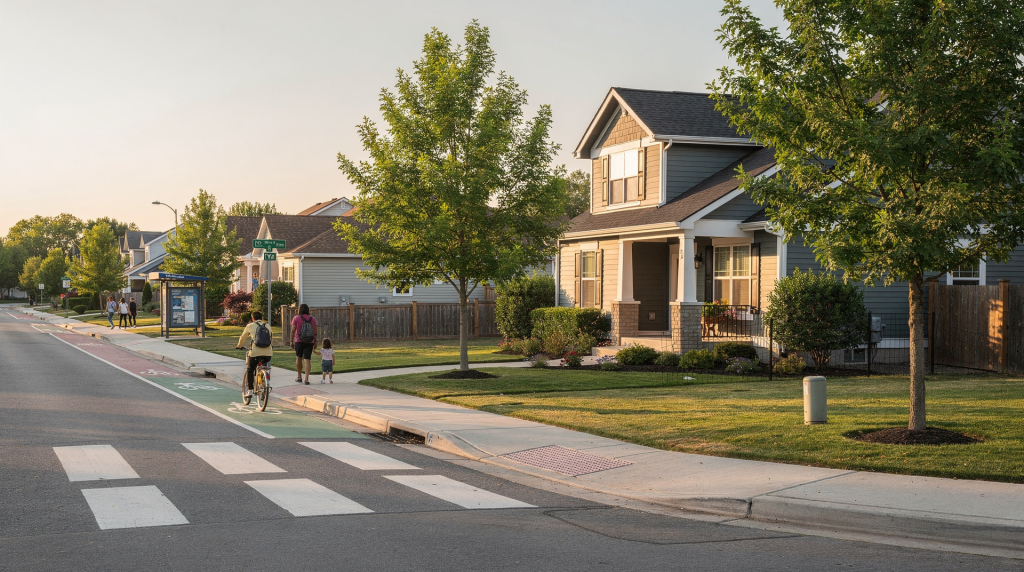
Walkability is one of the most practical lifestyle factors to assess before buying a suburban home—but it’s also one of the most overlooked determinants of long-term health. Years spent studying metabolic wellness and plant-based nutrition taught me something unexpected: the built environment often matters more than any supplement. If your neighborhood quietly discourages walking, you lose hundreds of hours of gentle, restorative movement each year. That’s a deficit no pill can fill. In the suburbs, walkability isn’t about ditching your car entirely. It’s about whether the places you need most—groceries, a park, a pharmacy, a coffee shop—are reachable on foot in a way that feels safe, pleasant, and repeatable. The real skill is learning to look past a generic score and evaluate how the neighborhood actually works for your body, your routine, and your peace of mind.
What “walkable” really means in a suburban setting
In a suburban context, walkability rarely implies a car-free life. It’s about whether walking is realistic, safe, and even enjoyable for the trips you actually make most often: school drop-off, a quick grocery run, a morning coffee, an evening stroll to the park, or reaching a transit stop without a second vehicle. A genuinely walkable suburban property usually has continuous sidewalks, safe street crossings, reasonable access to daily destinations, good lighting and visibility, streets that feel calm enough for pedestrians, and paths that remain usable in different weather conditions. The important question isn’t “Can I walk somewhere?” but “Can I walk there comfortably and repeatedly?” Comfort and repetition are what transform a walk from a one-off effort into a seamless daily habit—and that habit is where the health benefits quietly accumulate.
Start with your own daily routine
Before you study maps or neighborhood scores, define what “walkable” means for your life. A neighborhood that’s perfect for weekend recreation may be useless for weekday errands, and vice versa. Ask yourself: What do I want to reach on foot? How far am I comfortable walking on a regular basis? Do I need school access, transit access, or just exercise routes? Will children, guests, or older relatives use the sidewalks too? Do I want walkability for errands, recreation, or both? Being honest here prevents you from being seduced by a high walk score that doesn’t match your actual needs. Just as no single diet works for everyone, no single walkability profile fits every household.
Use a simple walkability checklist
A suburban home can look promising online and still fail in person. Use this checklist when evaluating the property to ground your assessment in physical reality rather than marketing language.
Infrastructure checklist
- Sidewalks exist on both sides, or at least on the side you would use most
- Sidewalks are continuous, not interrupted by long gaps that force you into the road
- Curbs are accessible and well-maintained
- Crosswalks are clearly marked
- Major intersections have signals or other pedestrian protections
- Streetlights are present and functional
- Trees, parked cars, hedges, or fences do not block visibility at corners
Destination checklist
- Grocery store within a realistic walking distance
- Pharmacy or clinic nearby
- Park, trail, or open space nearby
- Coffee shop, café, or other everyday stop nearby
- School, daycare, or community facility if relevant
- Transit stop if you want to reduce car dependence
Comfort checklist
- Traffic moves at manageable speeds
- Streets feel active, not isolated
- Sidewalks are wide enough for two people to walk side by side
- The route feels safe after dark
- The area looks maintained, not neglected
- Walking does not require crossing hostile or high-speed roads
Each of these points influences whether walking becomes a natural part of your day or a stressful event you avoid. For instance, a sidewalk that suddenly ends not only breaks your rhythm but also sends a subtle signal that pedestrians are an afterthought—and that discourages regular use.
Don’t trust a score alone
Walkability scores can be a useful starting point, but they don’t tell the whole story. A high score may reflect nearby destinations while the actual walk remains unpleasant because of traffic, missing sidewalks, or unsafe crossings. Many algorithms measure straight-line distance rather than the true pedestrian route, so a property can appear “close” to amenities on paper and still be functionally car-dependent. Use scores as a screening tool, not a final verdict. A better approach: check the score, look up the actual destinations behind it, measure the walking route (not the straight-line distance), verify whether the places are open and relevant to your life, and then visit the neighborhood yourself. Your own two feet are the most reliable assessment tool.
Walk the neighborhood at different times
A single daytime visit is never enough. The character of a neighborhood can shift dramatically between 2 p.m. and 8 p.m. Visit during morning rush hour, early evening, after dark, and on a weekend daytime. Each time reveals something different. Notice how many people are out walking, whether drivers slow down near crossings, whether sidewalks feel comfortable or awkward, whether lighting makes the area feel secure, whether noise levels change dramatically, and whether the area feels lived-in or empty. A street that feels charming in the afternoon may feel isolated and unsafe after sunset, and that unease will quietly erode your willingness to walk regularly. The best choice is the one that works throughout the day and across the week.
Map your real walking routes
Distance matters less than route quality. A half-mile walk across quiet, tree-lined streets can feel easier and more restorative than a shorter route across a six-lane road with no safe crossing. When reviewing a home, map the walk to the nearest grocery store, park, coffee shop or casual dining spot, school or daycare, transit stop, and pharmacy. Then check: Are there sidewalks the whole way? How many major roads must be crossed? Are crossings signalized? Is the route pleasant enough that you would actually use it—carrying groceries, with a child, or in less-than-ideal weather? Imagining yourself on that path with real-world burdens quickly separates theoretical walkability from practical, daily livability.
Compare walkability factors at a glance
| Factor | What to look for | Why it matters |
|---|---|---|
| Sidewalk continuity | No major gaps, broken paths, or forced road-walking | Gaps create hesitation and increase injury risk; they break the rhythm of a walk and discourage regular use |
| Crossings | Marked crosswalks, signals, refuge islands | Makes busy roads manageable and reduces the stress that can cancel out the calming effect of a walk |
| Traffic speed | Calm streets, ideally with traffic-calming measures | Speed determines whether a walk feels restorative or threatening; lower speeds also reduce accident severity |
| Lighting | Bright, consistent street lighting | Improves comfort after dark and extends the hours when walking feels safe and inviting |
| Destination access | Practical places within walking distance | Determines whether walking is useful, not just possible—and utility drives habit |
| Street design | Narrower roads, curb extensions, traffic calming | Encourages walking and lowers risk by naturally slowing drivers |
| Neighborhood activity | People outside, visible daily use | An active streetscape signals safety and community connection, which supports mental well-being |
Consider who will use the neighborhood
Walkability is not one-size-fits-all. Think about the people who will live there with you—their ages, abilities, and daily patterns—because a route that works for an able-bodied adult may be impossible for a child or an aging parent.
If you have children
Look for safe routes to school, few road crossings, slow traffic near the home, sidewalks wide enough for strollers, and parks that can be reached without crossing dangerous roads. The ability for a child to walk independently to a friend’s house or a playground isn’t just convenient—it builds physical confidence and a lifelong habit of active living.
If you work remotely
Look for walkable lunch spots, good evening walking routes, coffee shops or coworking options, and trails or parks for breaks during the day. A short walk at midday does more than clear your head; it counters the metabolic slowdown of prolonged sitting and can improve focus for hours afterward.
If you’re planning for aging in place
Look for gentle terrain, even sidewalks, benches or rest points nearby, clear crossings, and short, practical walks to essentials. These features aren’t just about convenience—they preserve independence, reduce fall risk, and maintain social connection when driving becomes less comfortable.
Common mistakes buyers make
Mistake 1: Confusing nearby with walkable
A store can be physically close and still inaccessible on foot because of roads, barriers, or lack of crossings. Even a 200-meter distance can become a wall if it requires crossing a high-speed arterial without a signal. Over time, that barrier often leads to abandoning walking altogether.
Mistake 2: Ignoring the return trip
A walk that feels fine going downhill or with the light behind you may feel very different coming back, especially in heat, rain, or darkness. The return trip often involves carrying items or fatigue, and if it’s punishing, the entire route becomes a deterrent.
Mistake 3: Focusing only on entertainment
A neighborhood with restaurants but no grocery store or pharmacy may be pleasant, but not truly convenient. For daily health, access to fresh food and medical care outweighs a charming café scene. Prioritize the errands that sustain your well-being.
Mistake 4: Forgetting weather and season
A sidewalk network that works in spring may be much less usable in snow, heavy rain, or extreme heat. Unshaded routes become oppressive in summer, and unplowed paths in winter can trap you at home. Assess how the infrastructure holds up across seasons.
Mistake 5: Assuming planned development is guaranteed
Future sidewalks, mixed-use centers, or trail connections may be advertised, but they are not the same as existing, usable infrastructure. Promises can be delayed or abandoned. Buy the walkability that exists today, not the one that might arrive someday.
Questions to ask during a showing
Use these questions to get past sales language and into real-world livability. They help reveal not just the physical infrastructure but the pedestrian culture of the area:
- Where do residents usually walk for errands?
- Is there a safe route to the nearest grocery store?
- How do people cross the major road nearby?
- Are sidewalks maintained by the city or the HOA?
- Is the area comfortable for walking at night?
- Are there any upcoming road projects that could improve or harm pedestrian access?
- Do neighbors use the sidewalks regularly?
A practical step-by-step process
Turn assessment into action with this sequence:
- Shortlist homes using map research. Look at nearby destinations, road layout, and sidewalk coverage before touring.
- Visit the neighborhood on foot. Park your car and actually walk the area. Don’t rely on driving through.
- Time the trip to essentials. Test the walk to the grocery store, park, or school. If the route feels inconvenient once, it may never become part of your routine.
- Check the safety details. Look for crossings, lighting, traffic speed, and visibility at corners.
- Revisit at a different time. Go back in the evening or on a weekend to see whether the neighborhood still works.
- Compare against your lifestyle. A suburban home may be perfect if you want a mostly car-based life with a few walkable perks. Be honest about what you actually need.
When walkability should matter more
Walkability should carry extra weight if you want daily movement built into your routine, you dislike driving for every errand, you have children who will walk independently, you expect to age in place, you want a healthier and more active lifestyle, or you value community interaction and outdoor time. In these cases, walkability isn’t a bonus feature—it’s a core component of the property’s long-term usefulness and your own preventive health strategy. An environment that naturally integrates walking into your day reduces the need for willpower or scheduled exercise, and that gentle, consistent activity is one of the most underrated tools for metabolic and cardiovascular health.
When it may matter less
Walkability may be less important if you want privacy and larger lots, you expect to drive for most errands anyway, you prioritize acreage, quiet, or rural access, you care more about interior features than neighborhood access, or you already live near strong commercial amenities elsewhere. The right choice depends on how much daily convenience you want built into your environment. Even then, consider whether there are on-property walking paths or quiet country lanes that can provide movement without destinations—because the need for daily motion doesn’t disappear with acreage.
Final buyer’s checklist
Before making an offer, confirm these points. They serve as a final gut-check that the property aligns with your long-term well-being:
- I know where I would walk for everyday needs
- The sidewalks are continuous enough to be practical
- Crossings feel safe enough for real use
- The area feels comfortable at different times of day
- The walk routes are realistic in bad weather
- The neighborhood supports my current and future lifestyle
- I have tested the area on foot, not just online
FAQ
What is a good walkability score for a suburban home?
A higher score can indicate better nearby access, but the score alone does not confirm safe or comfortable walking. Always verify the actual sidewalks, crossings, and routes. A score of 70 might still mean a harrowing walk along a stroad, while a 50 could offer a peaceful, connected network of paths.
Is a suburban property with no sidewalks automatically poor?
Not always, but it usually means walking will be limited or less safe. If sidewalks are missing, check whether streets are quiet enough and whether there are alternative paths. In very low-traffic areas, walking on the road edge can be acceptable, but this is the exception rather than the rule.
How far is “walkable” for most buyers?
For daily use, many buyers consider roughly a 10- to 15-minute walk practical. The real answer depends on traffic, weather, terrain, and who is walking. For an older adult or in extreme heat, even 10 minutes can feel daunting, while a flat, shaded half-mile might be a pleasure.
Should families prioritize walkability?
Yes, especially if children will walk to school, parks, or nearby amenities. Safe crossings and continuous sidewalks matter more than a nearby destination on paper. Early habits of walking foster independence and a lifelong comfort with active transportation.
Can walkability affect resale value?
Often, yes. Homes in more walkable areas tend to appeal to a broader group of buyers, especially those who value convenience and lifestyle access. As more people recognize the health and financial benefits of reducing car dependence, walkable suburbs are likely to hold their value well.
What is the biggest mistake when judging walkability?
Relying on maps or scores without walking the neighborhood in person. Real walkability is about the lived experience—the noise, the crossings, the feel of the street—not just distance. Your own sensory test is irreplaceable.
Conclusion
Evaluating walkability when buying a suburban property means looking at the whole daily experience: sidewalks, crossings, traffic, lighting, and access to the places you actually use. The best suburban home is not just close to amenities—it supports a lifestyle that feels safe, convenient, and easy to sustain over time. When your environment invites you to walk, you don’t have to schedule movement or rely on motivation; it simply becomes part of the rhythm of your day. That’s a quiet, powerful form of medicine, and it’s one of the most important investments you can make in your long-term vitality.