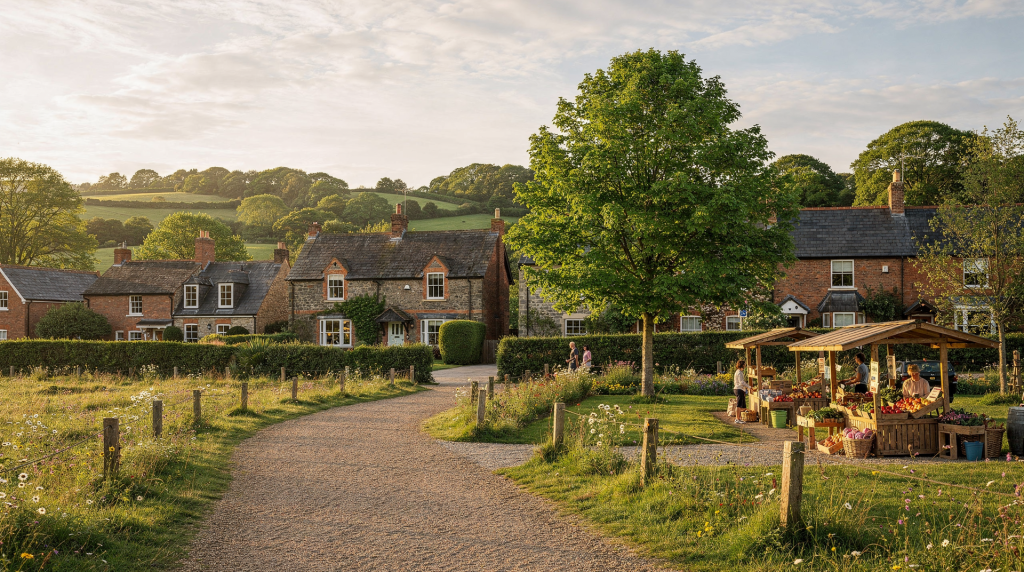
Finding a town where walking routes, green space, and local food are woven into daily life isn’t just about aesthetics—it’s about building an environment that makes healthier choices effortless. In England, the strongest candidates are often market towns and countryside edges where you can combine footpaths, farmers’ markets, and easy access to the outdoors without giving up practical amenities.
Why these towns matter
A good neighborhood is not just attractive on a map. It makes it easier to move more, eat better, and spend time outside without turning every healthy habit into a special trip. That is why towns with nature access, trails, and local food often feel easier to live in than places that look similar on paper.
From a metabolic perspective, the less friction between you and a healthy choice, the more likely that choice becomes a habit. When a walk by the river is just outside your door, you don’t need willpower—the environment does the work. The same goes for food: if you can pick up fresh, seasonal produce on your way home instead of making a dedicated drive to a supermarket, your plate shifts almost automatically toward what’s local and nutrient-dense. Over time, these small environmental nudges lower baseline stress, improve insulin sensitivity, and support a more resilient daily rhythm—something I’ve seen both in research and in my own transition from city living to a smaller, greener town.
The best-fit towns usually have three things in common:
- Public footpaths, towpaths, or long-distance trails nearby
- A weekly or monthly market with fresh local produce
- A compact center where you can run errands on foot
In England, places such as Keynsham, Midsomer Norton, Sudbury, Malton, and market towns near the Cotswolds or Lincolnshire Wolds show this pattern well, with walking networks, local markets, and strong food traditions.
What to look for in a nature-and-food town
1. Walkability to green space
A town can have countryside nearby and still be inconvenient if you must drive to reach it. The better option is a place where walking routes begin close to home or connect directly through town. This proximity matters because it removes the planning barrier—when you can step outside and be on a trail in minutes, daily movement stops being a scheduled task and becomes a natural extension of your day. Even a short, green walk has measurable effects on cortisol levels and heart rate variability, which compounds over weeks and months.
Look for:
- River paths, rail trails, and circular walks from the center
- Signed routes with varied distances
- Safe pavement connections to parks, woods, or fields
For example, the Bath area links towns and villages with the Monarch’s Way, the River Avon Trail, and the Bristol and Bath Railway Path, while the Cotswold Way offers over 100 miles of scenic walking on the western edge of the Cotswolds.
2. Reliable local food access
Local food does not mean an occasional artisan stall. A good town should have regular access to fresh produce, bakery items, dairy, meat, and pantry staples from nearby growers or producers. Consistency is what turns a nice-to-have into a genuine health asset. When you know you can buy vegetables harvested that morning or eggs from a farm a few miles away every single week, your diet naturally becomes more plant-forward and less processed—a shift that directly supports stable blood sugar and long-term metabolic health.
Strong signs include:
- Weekly farmers’ markets
- Monthly produce markets
- Local shops selling regional eggs, vegetables, cheese, and meat
- Food festivals or food trails that show an active local producer network
Midsomer Norton, for example, has a monthly farmers’ market with meats, fish, fruit, vegetables, local cheeses, and herbs, while Keynsham has a popular monthly market with local produce.
3. A compact, lived-in town center
The best towns for this lifestyle are practical, not polished in a tourist-only way. You want a place where people actually live, shop, walk, and eat year-round. A compact center reduces car dependence and encourages spontaneous physical activity—walking to the baker, the greengrocer, or the pharmacy adds up to significant weekly energy expenditure without formal exercise. It also fosters a sense of community, which itself is a buffer against chronic stress.
A good center usually includes:
- Independent food shops
- A high street with everyday services
- Cafes, pubs, and casual dining
- A visible community rhythm, especially on market days
This matters because a town with nature and food access should make daily life easier, not just weekend outings more pleasant.
Best types of towns to target
Market towns
Market towns are often the strongest choice because they were built around trade, local produce, and community life. Many still have active markets and walkable centers. Their historic layouts were designed long before cars, which means human-scale streets and easy connections to surrounding fields and commons—exactly the kind of infrastructure that supports health passively.
Why they work well:
- Strong local food culture
- Historic compact layouts
- Good access to surrounding countryside
- Easy weekend routines without long drives
Examples from current travel and regional guides include Malton, Ludlow, Sudbury, and towns in the Lincolnshire Wolds and around Bath.
Towns near long-distance trails
If hiking or regular long walks matter, look for towns near national or regional routes. These towns usually support outdoor living better than isolated villages because they combine trails with services. Living near a well-maintained trail network means you can build a routine of longer weekend walks or even daily section hikes, which does wonders for cardiovascular fitness and mental clarity.
Useful trail-adjacent examples include:
- Cotswold Way towns and villages
- River trail towns in the Bath area
- Villages and towns linked to the Viking Way and other Wolds routes
Small towns near countryside but not too remote
The sweet spot is often a place with countryside access and enough infrastructure for daily life. That means groceries, healthcare, schools, and transport still exist, but the town opens quickly into fields, woods, or coastline. This balance protects against the isolation that can sometimes accompany rural living while still delivering the restorative benefits of nature—lower noise, cleaner air, and more opportunities for unstructured outdoor time.
This balance is common in towns near the New Forest, the Cotswolds, the Lake District, and other walkable English landscapes.
A practical scoring method for choosing a town
Use this simple checklist when comparing places. I’ve found that rating each category forces you to look beyond a pretty high street and consider how the town will actually shape your daily rhythms, stress levels, and long-term vitality.
| Feature | What good looks like | Why it matters |
|---|---|---|
| Trails | At least one walkable route from the town center | Makes outdoor activity easy to repeat |
| Green space | Park, river path, woodland, or open countryside nearby | Supports stress reduction and regular movement |
| Local food | Weekly market or strong monthly market | Improves access to fresh, seasonal food |
| Daily errands | Shops, pharmacy, and services in town | Reduces car dependence |
| Community feel | Visible market days, cafes, and local events | Helps the area feel lived-in, not seasonal |
| Transport | Train or bus access if needed | Keeps the town practical long term |
How to research a town properly
Step 1: Map the walking options
Do not stop at “near nature” marketing. Check whether there are actual routes you can use. I’ve learned to pull up a detailed Ordnance Survey map and trace paths from the town center outward—if I can’t find a pleasant, traffic-free loop within a mile, the town likely won’t deliver the daily movement I’m after.
Ask:
- Can I walk from the center to countryside within 10–20 minutes?
- Are there loop walks for different fitness levels?
- Are routes usable year-round, not just in summer?
Step 2: Check market frequency
One charming market is not enough. Look for regularity. A weekly market creates a reliable rhythm for sourcing fresh ingredients, while a monthly one can still work if supplemented by permanent farm shops or local grocers. The goal is to make seasonal, minimally processed food the default, not the exception.
A useful market calendar may include:
- Weekly town markets
- Monthly farmers’ markets
- Seasonal food events
- Nearby farm shops or pick-your-own farms
Step 3: Visit on an ordinary day
A town can look great on a sunny Saturday and feel flat on a Tuesday afternoon. Visit during a normal weekday to see:
- Traffic levels
- Noise
- Parking pressure
- Whether the center feels active
- How easy it is to walk without getting in the car
Step 4: Talk to locals about daily routines
Ask residents where they buy produce, where they walk, and whether they actually use the town center. That tells you more than any brochure. When I was scouting my own move, a five-minute chat at a café revealed more about the real community rhythm than hours of online research.
Best signs that a town supports healthier living
A town that supports well-being usually has these traits:
- You can walk for 30 minutes without repeating the same street
- Fresh food is available without a long drive
- Outdoor space is part of daily life, not a special destination
- The community values markets, local producers, and public paths
- The area feels calm enough for regular use, not just occasional visits
These are the details that turn a pleasant location into a genuinely livable one. Over time, they quietly lower allostatic load—the wear and tear on the body from chronic stress—by making restorative activities the path of least resistance.
Common mistakes buyers and renters make
Choosing scenery over access
A beautiful rural view does not help much if the nearest shop, doctor, or bus stop is too far away. I’ve seen people trade walkability for a postcard panorama, only to find themselves driving thirty minutes for a carton of milk—a daily friction that erodes the very wellness they sought.
Ignoring seasonality
Some towns feel vibrant in spring and summer but much quieter in winter. If year-round livability matters, check how active the town remains outside peak season. A place that hibernates for four months can feel isolating and may lack the fresh food access you rely on.
Overlooking route quality
A trail is only useful if it is well connected, safe, and pleasant to use. A footpath that starts on a dangerous road edge will not become a real habit. Look for continuous, well-maintained paths where you can walk without constant noise or traffic stress—otherwise the supposed health benefit is undermined by the very environment you’re trying to escape.
Assuming every “local food” area has real choice
Some places have one good farm shop and little else. Look for depth: markets, producers, bakeries, butchers, greengrocers, and nearby food events. A diverse local food web not only improves your diet but also strengthens the local economy, which in turn keeps the town vibrant and services alive.
Quick comparison of strong town features
| Town type | Nature access | Local food | Practical daily life | Best for |
|---|---|---|---|---|
| Market town near trails | High | High | High | Buyers wanting balance |
| Rural village | Very high | Low to medium | Medium to low | People prioritizing quiet |
| Suburban town near green belts | Medium to high | Medium | High | Families needing services |
| Tourist town | High | Medium to high | Medium | Lifestyle buyers, part-time living |
A simple home-search framework
When evaluating a neighborhood, rank each category from 1 to 5:
- Nature access
- Walkability
- Local food
- Community feel
- Convenience
- Year-round livability
A neighborhood scoring well in all six is usually a stronger long-term choice than one with only beautiful scenery. In my experience, these scores correlate surprisingly well with how calm, energized, and connected residents report feeling months after moving in—because the environment is doing the heavy lifting for their health.
Who these towns suit best
These places tend to work especially well for:
- Remote workers who want better daily routines
- Families who value outdoor time and good food
- Active retirees
- Buyers seeking a slower pace without complete isolation
- Anyone trying to build healthier habits through environment
For those already leaning toward a plant-forward or whole-foods approach, the combination of walkable green space and reliable local markets creates a powerful feedback loop—one that makes nutritious eating and regular movement feel less like discipline and more like a natural part of the day.
Final take
The best towns with nature, trails, and local food are not the most picturesque on a postcard. They are the ones that make healthy choices easy every day. In England, that usually means market towns and countryside-edge communities where walking routes, fresh produce, and practical amenities sit close together. When your surroundings do the nudging, you get to spend less energy on willpower and more on actually living well.
FAQ
What makes a town good for nature and local food?
A good town has walkable access to trails or green space, plus regular markets, farm shops, or local food producers. The key is that these resources are integrated into the town’s layout, not isolated attractions you must drive to.
Are market towns usually a good choice?
Yes. Market towns often combine local food culture, compact centers, and access to countryside paths. Their historic design naturally supports the kind of low-stress, high-movement lifestyle that benefits metabolic and mental health.
Should I prioritize trails or food access first?
If possible, choose a town that offers both. Trails support daily movement; local food supports easier, healthier routines. Together they create a reinforcing cycle that’s greater than the sum of its parts.
How do I know if a town is livable year-round?
Visit on a weekday, check winter activity, and look for permanent services, not just seasonal attractions. A town that maintains its rhythm through all seasons will feel more stable and supportive long-term.
What is the biggest red flag?
A town that looks beautiful but requires driving for every errand is often less practical than it first appears. The hidden cost is time, stress, and a gradual erosion of the spontaneous healthy habits you moved there to cultivate.