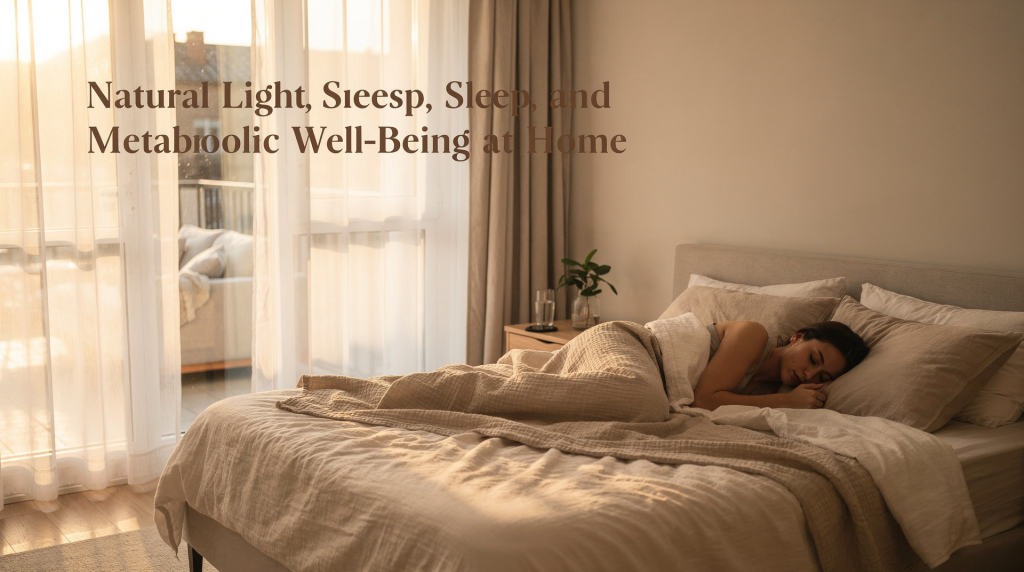
When we talk about a healthy home, we tend to focus on air quality, non-toxic materials, or maybe proximity to green space. But there’s another factor that quietly shapes our health every waking and sleeping hour: light. Not just the presence of windows, but the way natural and artificial light interact with our internal clocks. This relationship affects not only how well we sleep tonight, but also how our bodies handle glucose tomorrow.
If you want a home that genuinely supports your well-being, start treating daylight, evening lighting, and bedroom darkness as core elements of your health strategy—not as afterthoughts in a design plan.
Why light matters for metabolic health
Your body runs on a 24-hour internal clock called the circadian rhythm, which coordinates sleep, alertness, hormone release, and metabolism. Light is the most powerful external cue that tells this clock when it’s daytime and when it’s time to wind down. When daytime light is strong and consistent, the body more easily stays aligned with a healthy sleep-wake pattern. When nighttime light is too bright, the brain receives mixed signals, which can interfere with melatonin production, sleep quality, and the intricate metabolic processes that regulate blood sugar.
This isn’t just theory. Research has shown that even modest light exposure during sleep can alter insulin sensitivity and glucose regulation the next morning. In other words, the lighting choices you make at home can have a direct, measurable impact on your metabolic health.
The simple version
- Bright light in the morning helps you wake up and stay alert throughout the day.
- Dim, warm light in the evening signals to your brain that it’s time to prepare for sleep.
- Light during sleep—even a faint glow—can worsen glucose regulation and insulin sensitivity the following morning.
How natural light supports better sleep
Natural daylight, especially in the morning, anchors your body clock to the external world. That anchoring makes it easier to fall asleep at night and wake up at a consistent time in the morning, often without relying on an alarm. Studies have linked stronger daylight exposure with earlier sleep timing, deeper sleep, and better overall sleep quality.
In practical terms, a home with good daylight access turns healthy routines into something effortless. When your kitchen is flooded with morning sun, you don’t need willpower to get that crucial early light exposure—it simply happens as part of your day.
What helps most
- Morning light exposure within the first hour after waking, ideally while you’re having breakfast or stepping outside.
- Daytime time outdoors, even if it’s just a short walk or a few minutes on the porch with a cup of coffee.
- Open sightlines to windows in the rooms where you spend the most time, so daylight reaches your eyes without obstruction.
Why nighttime light is a problem
The human body is designed for darkness at night. Even moderate indoor lighting during sleep has been associated with higher insulin resistance and poorer cardiometabolic regulation the next morning. This doesn’t mean you need to live in a blackout bunker, but it does mean the bedroom should be protected from unnecessary light—especially from screens, nightlights, hallway spill, and bright outdoor sources like streetlamps or security lights.
What’s often overlooked is the cumulative effect of tiny light sources: the LED on a charger, the glow of a digital clock, or the sliver of light under the door. These seemingly insignificant signals can disrupt melatonin production and fragment sleep architecture, quietly undermining metabolic recovery.
Home lighting habits that support sleep and metabolism
The goal isn’t to live in the dark. It’s to create a strong, intentional contrast between day and night. Here’s what that looks like in practice.
| Time of day | Best lighting strategy | Why it helps |
|---|---|---|
| Morning | Bright natural light, open curtains, step outside if possible | Signals wakefulness and reinforces circadian timing, setting a healthy metabolic rhythm for the day |
| Midday | Keep spaces bright, use daylight whenever possible | Supports alertness and maintains a stable daytime rhythm, which helps regulate appetite and energy |
| Evening | Dim lights, use warmer tones, reduce screen brightness | Helps the body shift toward sleep mode by allowing melatonin to rise naturally |
| Night | Keep bedroom dark, remove unnecessary LEDs and light leaks | Supports melatonin and better overnight metabolic regulation, improving insulin sensitivity by morning |
Bedroom design choices that make a real difference
A sleep-friendly bedroom is usually simpler than people expect. The biggest wins come from reducing light sources, not from buying expensive gadgets. Often, a few intentional tweaks can transform the room into a sanctuary for restorative sleep.
High-impact changes
- Use blackout curtains or shades if outdoor lighting reaches the bedroom, especially from streetlights or early morning sun.
- Cover or remove bright indicator lights on chargers, alarms, and appliances—those tiny blue or green dots can be surprisingly disruptive.
- Keep the bedside lamp low and warm if you need light at night; a dim, amber-toned bulb is far less stimulating than a bright white one.
- Turn screens off earlier, or at least lower brightness and reduce blue-light exposure in the evening. Many devices now have built-in night modes that shift the display to warmer hues.
- Use an eye mask if the room cannot be fully darkened—this is a simple, travel-friendly solution that works immediately.
Common mistakes
- Sleeping with the TV on, which floods the room with flickering, blue-rich light all night.
- Using a bright bathroom light during nighttime wake-ups, which can jolt the brain into alertness and make it harder to fall back asleep.
- Leaving curtains partially open with street lighting outside, creating a constant low-level glow in the room.
- Relying on a nightlight that is brighter than necessary—often, a very dim, motion-activated light is enough for safety.
- Spending the evening under strong overhead lighting, then expecting to fall asleep immediately. The body needs time to transition.
A practical evening routine for better sleep
A good routine doesn’t need to be complicated. It just needs to be consistent. The following steps help your brain clearly separate “active time” from “rest time,” which is central to both sleep quality and metabolic balance.
Step-by-step reset
- Start dimming lights 1 to 2 hours before bed. This can be as simple as switching from overhead fixtures to a single low lamp.
- Turn off overhead lighting and use one warm, low-level lamp if you need illumination.
- Stop intense screen use or reduce brightness and blue light exposure. If you must use a device, enable night mode and keep it at arm’s length.
- Keep the bedroom cool, dark, and quiet. A temperature around 65°F (18°C) is often ideal for sleep.
- Get to bed at roughly the same time each night, even on weekends. Consistency reinforces your circadian rhythm.
How home layout affects your circadian rhythm
The amount of daylight in a home isn’t just about window size. It also depends on how your rooms are arranged and how often you move through naturally lit spaces during the day. A well-designed layout can passively support your circadian health without requiring extra effort.
Helpful layout features
- South-facing or otherwise bright living areas that invite you to spend time in daylight.
- A kitchen or breakfast area that catches morning sun, making it easy to get early light exposure while you start your day.
- A work-from-home setup positioned near a window, so you benefit from daylight even during focused tasks.
- Bedrooms placed away from streetlights and evening glare, ideally on a quieter, darker side of the home.
- Outdoor access that makes short daylight breaks effortless—a balcony, patio, or garden door you’re likely to use.
Homes with good daylight access make it easier to build healthy habits without conscious effort. That matters because daily routines are strongly tied to circadian stability and long-term metabolic health. When your environment does some of the work for you, consistency becomes far more sustainable.
Light, meal timing, and energy balance
Light doesn’t work in isolation. It interacts with when you eat, move, and sleep. Circadian biology research shows that the body’s daily rhythms coordinate feeding, activity, hormone secretion, and energy use. That’s why late-night light exposure can be so disruptive: it sends a “still awake” signal at the very time your body should be settling into rest and fasting. Over time, this mismatch can make healthy routines harder to sustain and may contribute to weight gain and insulin resistance.
A simple rule of thumb
- Eat your larger meals earlier in the day when possible, aligning food intake with your body’s natural peak metabolic efficiency.
- Keep evenings calmer, darker, and less stimulating—this isn’t just about light, but about creating a buffer zone between the day’s activity and sleep.
- Use morning light to start the day, not caffeine alone. A few minutes of sunlight can be more effective than an extra cup of coffee for lasting alertness.
What to look for when choosing a home
If sleep and metabolic well-being matter to you—and they should—sunlight access deserves a spot on your home-search checklist. The right light environment can act as a silent health partner, while the wrong one can quietly work against you.
Good signs
- Plenty of natural light in the rooms you use most, especially during the morning and early afternoon.
- Bedrooms that can be fully darkened, with window placements that allow for effective light control.
- Low outside light pollution—no bright streetlights or commercial signage shining directly into sleeping areas.
- Space to spend time outdoors each day, whether it’s a small yard, a balcony, or a nearby park.
- A floor plan that supports morning and daytime light exposure in the areas where you naturally spend time.
Red flags
- A bedroom directly exposed to streetlights or security lights that cannot be easily blocked.
- Heavy reliance on artificial light during daytime hours because windows are small, poorly placed, or shaded by neighboring buildings.
- Open-plan spaces that remain bright at night due to light spill from adjacent units or common areas.
- No practical way to block light in sleeping areas—for example, windows without curtain rods or awkward shapes that make blackout solutions difficult.
When you walk through a property, pay attention to how light behaves at different times of day. A home that feels bright and cheerful in the morning but allows for true darkness at night is a powerful foundation for metabolic health.
Quick checklist for a healthier home light environment
- Morning light reaches your eyes soon after waking, ideally within the first hour.
- Daytime rooms are bright without feeling harsh or causing glare.
- Evening lights are warm and dim, creating a noticeable shift in atmosphere.
- Screens are reduced or managed before bed, with brightness and blue light minimized.
- The bedroom is dark enough for uninterrupted sleep—no glowing indicators or light leaks.
- Outdoor light does not leak into the sleeping space, even when curtains are drawn.
FAQ
Does natural light really affect metabolism?
Yes. Circadian rhythms help regulate sleep, feeding, hormone release, and energy balance, and light is the main signal that sets those rhythms. When light exposure is well-timed, metabolic processes tend to run more smoothly.
Is bedroom darkness actually important?
Absolutely. Even moderate room light during sleep has been linked to impaired glucose regulation and higher insulin resistance the next morning. Darkness supports the overnight metabolic reset your body needs.
What is the most important light habit to improve sleep?
Get bright natural light in the morning and reduce light exposure at night. This simple contrast is the foundation of a healthy circadian rhythm.
Are blackout curtains worth it?
For many people, yes. If your bedroom gets streetlight or porch-light spill, blackout curtains can meaningfully improve darkness during sleep. They’re one of the most cost-effective upgrades you can make for your sleep health.
Can warm light still affect sleep?
Yes, if it is bright enough or used too close to bedtime. Warmer light is generally less stimulating than white or blue light, but dimming still matters. The key is to reduce overall light intensity in the hours before sleep.
Final thought
A healthier home often starts with something as basic as daylight. Strong morning light, softer evenings, and a truly dark bedroom can support better sleep and more stable metabolic function over time. If you are designing a home, improving one, or choosing between properties, treat light quality as a wellness feature—not an afterthought. The spaces we inhabit are not just backdrops to our lives; they actively shape our health, and light is one of their most powerful tools.