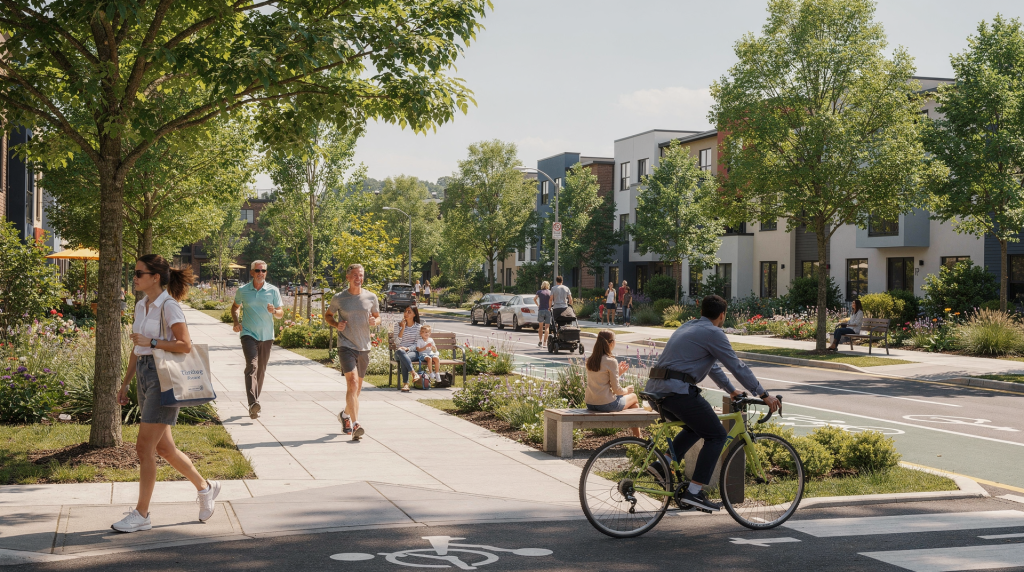
How Walkability and Access to Nature Support Active Living
A neighborhood designed for walking—and one that weaves nature into daily life—does something remarkable: it makes movement feel less like a task and more like a natural extension of your day. When sidewalks lead somewhere useful and a trailhead sits just beyond your doorstep, the default setting shifts from sitting to moving. This isn’t about scheduling exercise; it’s about an environment that quietly, persistently invites you to walk, bike, or simply be outside.
Why This Matters for Active Living
Active living is fundamentally different from structured workouts. It’s the accumulated movement that happens when your surroundings encourage walking to pick up groceries, cycling to meet a friend, or taking the long way home through a park. This kind of movement doesn’t require a gym membership or a burst of motivation—it’s woven into the fabric of your location.
The distinction is crucial because most people struggle to sustain rigid fitness regimens. What does stick, research shows, are the small, repeated decisions to move that a well-designed neighborhood prompts almost automatically. When every errand doesn’t demand a car key, you accumulate activity in a way that feels effortless. Over weeks and months, those micro-movements add up to a far more consistent health impact than a weekly gym session that might get skipped.
What Walkability Actually Means
Walkability isn’t a vibe or a real estate buzzword—it’s a measurable quality that describes how safe, practical, and inviting an area is for getting around on foot. It answers a simple question: can you comfortably and safely walk to the places you need to go?
In practice, a truly walkable neighborhood typically offers:
- Continuous, well-maintained sidewalks that don’t abruptly end
- Street crossings that feel safe, with reasonable traffic speeds and clear visibility
- Everyday destinations—groceries, a café, a pharmacy—within a 10- to 15-minute walk
- Connected street grids rather than sprawling cul-de-sacs that force long detours
- Parks, schools, libraries, or services reachable without a car
- Lighting and traffic-calming measures that make walking feel secure at different times of day
One of the most common misconceptions is equating walkability with density alone. A compact city block can still be unwalkable if it lacks safe crossings or useful destinations. True walkability emerges from the interplay of connected streets, proximity to daily needs, and pedestrian-first design—not just square footage per mile.
How Walkability Supports Health
The link between walkable neighborhoods and better health outcomes is not anecdotal—it’s consistently reflected in population-level research. When the built environment makes walking the easier choice, people move more.
One telling data point: individuals who relocated to more walkable cities added roughly 1,100 steps to their daily count. That may sound modest, but over a week it represents nearly an extra hour of walking—no extra effort, no new routine, just a different setting. Other studies reinforce this pattern, connecting higher neighborhood walkability with more weekly walking minutes, improved physical activity levels, and measurably lower predicted cardiovascular risk.
What’s particularly striking is that these gains don’t depend on people consciously trying to exercise more. The environment does the heavy lifting by removing friction between intention and action.
Health Benefits Most Often Associated with Walkable Areas
| Benefit | Why it happens |
|---|---|
| More daily movement | Walking becomes the default for errands and short trips, not a separate activity to schedule |
| Better cardiovascular health | Consistent, low-intensity movement throughout the day supports heart function and lowers key risk factors |
| Lower diabetes risk | Regular, routine activity improves insulin sensitivity and metabolic regulation over time |
| Better mood and sleep | Outdoor movement, especially in daylight, helps regulate circadian rhythms and reduce stress hormones |
| Less sedentary time | Walkable design reduces car dependence and breaks up long periods of sitting that harm metabolic health |
The thread running through all of these is consistency. A neighborhood that invites walking doesn’t rely on willpower—it turns healthy behavior into the path of least resistance.
Why Access to Nature Adds Another Layer of Support
Nature does more than beautify a streetscape. Parks, tree-lined paths, creeks, and open meadows create what psychologists call “restorative environments”—places that lower stress markers and invite people to linger, move, and return. In the context of active living, nature functions as both a destination and a motivator.
Access to green space supports movement in three practical, overlapping ways:
- It provides a compelling reason to go outside—a trail to explore, a shaded loop for a morning walk, a place for kids to play without screens.
- It makes physical activity feel less like a chore. A walk through a wooded path is qualitatively different from a walk along a busy arterial road; one restores, the other drains.
- It encourages recovery, not just exertion. True wellness isn’t only about steps and heart rate—it’s also about moments of quiet, breathing fresh air, and letting the nervous system downshift. Nature delivers that in a way a sidewalk alone cannot.
This is why a neighborhood with a trail system or a well-integrated park often outperforms one with sidewalks but no green respite. The combination addresses both the physical and psychological dimensions of health.
Walkability vs. Green Space: They Work Best Together
The most supportive environments don’t force a choice between walkability and nature—they layer both. Walkability embeds movement into the logistics of daily life, while green space makes that movement something you actually want to do, day after day.
Example:
- A walkable suburban neighborhood lets you stroll to morning coffee, walk children to school, or grab a few items from a local market without starting the car.
- A nearby park or trail network offers a setting for longer walks, weekend bike rides, and the kind of mental reset that a busy street can’t provide.
- Together, they generate more total movement—and a more sustainable relationship with physical activity—than either feature could alone.
Think of it as the difference between a tool and a habitat. Walkability is the tool that makes movement efficient; nature is the habitat that makes it meaningful.
What to Look For When Evaluating a Neighborhood
If active living is a priority—and from a wellness perspective, it should be—the house itself is only part of the equation. The surroundings determine whether movement flows naturally or requires constant negotiation.
Neighborhood checklist
- Can you reach a park, trail, or usable green space without getting in the car?
- Are sidewalks continuous along the routes you’d actually use, or do they appear and disappear unpredictably?
- Can you safely cross streets near the destinations that matter—groceries, schools, a library?
- Are there everyday errands within a realistic 10–15 minute walk, or is every trip car-dependent?
- Do streets connect in a way that makes walking direct and intuitive, or are you forced into long, looping detours?
- Is there tree cover, shade, or greenery that makes walking comfortable in summer and psychologically inviting year-round?
- Does the area feel safe and welcoming for walking at different times of day—morning, evening, and after dark?
Red flags
- Dead-end street patterns with no pedestrian cut-throughs, trapping residents in car-only loops
- High-speed roads that sever homes from parks, shops, or schools, making walking feel dangerous even if distances are short
- Sidewalks that are narrow, broken, or missing entirely on key routes
- Landscaped “green” areas that look attractive from a car but offer no real access—no paths, no benches, no invitation to enter
- Parks that exist on a map but require a drive to reach, negating the spontaneous, daily use that drives health benefits
A Simple Framework for Buyers and Renters
When assessing a potential home through a wellness lens, I use a three-part test that cuts through real estate marketing and gets to what actually shapes daily behavior:
- Daily walk test: Can you walk to at least one genuinely useful destination—a café, a market, a post office—without planning it as a special outing? If the answer is no, the neighborhood is designed around cars, not people.
- Movement test: Are there places nearby where walking, biking, or playing outside feels easy, safe, and natural? This isn’t about designated exercise zones; it’s about whether the built environment invites spontaneous activity.
- Recovery test: Is there access to nature that helps you decompress, not just burn calories? A bench under a tree, a quiet trail, a creek—spaces that signal to your nervous system that it’s okay to slow down.
If a neighborhood passes all three, it’s far more likely to support the kind of active, balanced lifestyle that sustains health over decades, not just weeks.
Common Mistakes People Make
- Choosing a large, impressive house in a car-dependent subdivision and assuming they’ll “get more active later”—while the environment quietly works against that intention every single day.
- Confusing the existence of a park somewhere in the zip code with true, walkable access to nature that gets used regularly.
- Focusing entirely on kitchen finishes and square footage while ignoring street design, traffic patterns, and pedestrian infrastructure—the factors that shape health far more than countertop material.
- Underestimating how much traffic speed, crossing safety, and sidewalk continuity affect whether they—or their children—will actually walk anywhere.
- Assuming all suburban neighborhoods are interchangeable, when in reality some are movement-friendly and others are engineered for sedentary living.
The environment shapes behavior more than we like to admit. If daily movement requires a deliberate, effortful choice every time, even the best intentions tend to erode. The goal is to find a place where the healthy choice is the easy choice.
Practical Ways to Add More Movement Where You Live
Not everyone can move to a walkable, nature-rich neighborhood tomorrow. But there are ways to nudge your current environment toward more activity, even within constraints:
- Identify one errand you can walk to each day—even if it’s just picking up a few items or mailing a letter—and protect that as a non-negotiable habit.
- Choose the route with the best sidewalk, shade, and safety, even if it adds a few minutes. The quality of the walk matters as much as the distance.
- Use nearby parks and trails for repeatable, short loops rather than saving them for weekend excursions. A 15-minute daily walk in a green space beats an hour-long hike once a month.
- Anchor walks to existing routines—right after morning coffee, before dinner, or as a transition out of the workday—so they become automatic rather than optional.
- Keep walking shoes by the door. It sounds trivial, but reducing the friction between impulse and action has an outsized effect on follow-through.
- Suggest walking meetups instead of sitting for coffee or drinks. Social connection and movement don’t have to be separate activities.
Each of these adjustments reduces the number of decisions standing between you and movement. Over time, that’s what builds consistency.
Who Benefits Most from Walkable, Nature-Rich Neighborhoods?
While everyone gains from an environment that supports movement, certain groups experience particularly pronounced benefits:
- Families with children who want outdoor play to happen organically, without scheduling and driving to a playground.
- Remote workers who need built-in reasons to leave the house and break up long sedentary stretches—a walkable coffee shop or a lunchtime trail loop can restructure the entire day.
- Adults aiming to increase daily steps without committing to a formal gym routine that may not stick.
- People managing metabolic health conditions for whom consistent, low-intensity movement is a cornerstone of blood sugar regulation and insulin sensitivity—and for whom an environment that supports this can be as important as any supplement.
- Anyone feeling mentally drained by a car-dependent lifestyle that replaces movement with traffic, parking, and prolonged sitting.
In each case, the neighborhood functions as a kind of invisible health infrastructure—one that either supports vitality or quietly erodes it.
Final Takeaway
Walkability and access to nature aren’t lifestyle amenities—they’re foundational health tools embedded in the places we live. They support active living not by demanding more discipline, but by making movement easier, more frequent, and less dependent on the daily fluctuations of motivation. The best wellness-oriented neighborhoods don’t just offer a beautiful house; they create the conditions under which walking, recovery, and outdoor time become as natural as breathing. When we choose where to live, we’re making a decision about our long-term health—one that’s just as consequential as what we eat or how we manage stress.
FAQ
Is walkability more important than having a big yard?
Not inherently, but walkability typically influences daily movement more directly. A large yard offers private outdoor space, which has its own value, but it doesn’t replace the health benefits of sidewalks that connect to real destinations, safe street crossings, and a neighborhood layout that encourages walking as part of everyday life.
Do you need a city to live an active lifestyle?
Absolutely not. Many small towns and thoughtfully designed suburban areas support active living beautifully—provided they have the right ingredients: continuous sidewalks, trail networks, parks within walking distance, and daily needs clustered close enough to reach on foot. The key is design, not density.
Can nature really affect how much people move?
Yes, and the mechanism is straightforward: nature doesn’t force activity, but it makes movement more appealing, more enjoyable, and therefore more repeatable. When a walk feels restorative rather than utilitarian, people are far more likely to do it again tomorrow.
What is the easiest way to spot a walkable neighborhood?
Look for three things in combination: connected, continuous sidewalks; safe street crossings near actual destinations; and everyday errands—groceries, a pharmacy, a café—within a 10- to 15-minute walk. If those three elements are present, the neighborhood is likely walkable in a practical, daily-use sense.
Why do walkable areas matter for long-term health?
Because they increase daily movement in a way that’s easier to sustain over years and decades. That consistency—not intensity—is what drives long-term benefits for cardiovascular health, metabolic function, and mental well-being. An environment that supports this kind of steady, low-effort activity is one of the most underrated investments in long-term health.