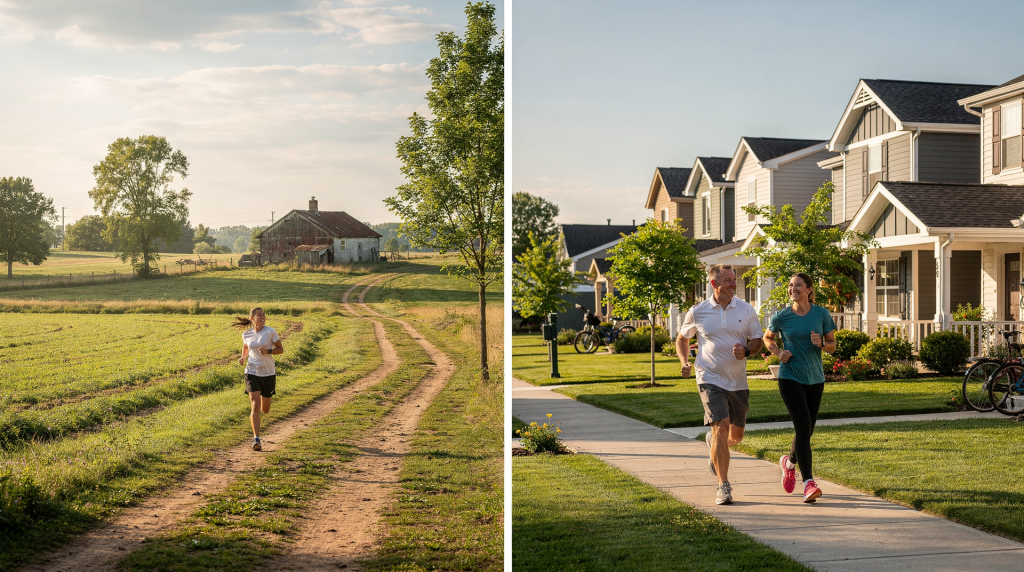
When I first started writing about health, my focus was narrow: blood sugar curves, plant-based meal timing, the quiet metabolic work of natural supplements. But the longer I studied why some people thrive and others struggle, the more I kept bumping into an uncomfortable truth — environment matters as much as anything you put on your plate. You can optimize your nutrition down to the gram, but if your daily surroundings are loud, polluted, isolating, or designed to keep you in a car, your body feels it. Choosing where to live is, in a very real sense, a health intervention. And the question I hear most often from wellness-minded buyers is deceptively simple: rural or suburban?
Neither is inherently healthier. What tips the balance is how a place shapes your daily movement, your stress baseline, your access to care, and whether the environment quietly nudges you toward vitality or slowly drains it. Let’s walk through what actually changes between these two settings — and how to think about the decision through a wellness-first lens.
Rural vs. Suburban Living: What Actually Changes?
At a practical level, rural and suburban areas differ in density, mobility, and environmental exposure. Suburbs usually offer closer access to schools, shopping, and services, while rural areas offer more space, quieter surroundings, and stronger contact with nature. Health outcomes tend to vary because of those design differences rather than geography alone.
What’s less obvious is how these structural differences compound over time. Living five miles from a grocery store versus half a mile isn’t just about convenience — it changes how often you walk, how you plan meals, how much time you spend behind the wheel, and how easily you can grab fresh produce on a whim. These small daily patterns accumulate into metabolic consequences, stress loads, and long-term health trajectories that are easy to overlook when you’re focused on square footage and lot size.
The Health Benefits of Rural Living
Rural life often appeals to people who want more space, slower rhythms, and a stronger connection to nature. For many households, that translates into lower stress and more time outdoors — but the mechanism is worth unpacking. It’s not just about having a bigger yard; it’s about how that space reshapes your nervous system over months and years.
Potential advantages of rural living
- More daily exposure to green space and natural surroundings
- Less traffic noise and fewer dense urban disruptions
- More room for gardens, walking paths, and outdoor activity
- A stronger sense of privacy and separation from crowding
- In some settings, better air quality than heavily traffic-loaded areas
What I’ve noticed, both in the research and in my own transition from a dense urban center to a small rural town, is that the benefits compound quietly. You sleep deeper when the night is actually dark and quiet. You move more when stepping outside feels inviting rather than overwhelming. You cook differently when you have space for a garden and the mental bandwidth to tend it. These aren’t dramatic transformations — they’re slow, cumulative shifts that add up to a fundamentally different physiological baseline.
Where rural living can support health
Rural settings can make it easier to build routines around walking the property, gardening, spending time outside, and creating calmer sleep environments. Research summaries also note that rural residents may benefit from better physical-environment conditions, including cleaner air in some areas, fewer housing issues, and a greater sense of community belonging.
That last point — community belonging — surprises people who assume rural life is isolating. In practice, small towns and rural areas can foster remarkably tight social bonds, the kind where neighbors check in, share resources, and show up during hard times. From a health perspective, social connection is protective: it buffers stress, improves mental health outcomes, and even correlates with lower inflammation markers. A rural community that fits you well can be a powerful health asset, not a liability.
The tradeoffs to watch
Rural living is not automatically healthier. Rural residents can face higher death rates from unintentional injuries, COPD, and suicide compared with suburban residents. Rural life can also mean longer drives, fewer nearby services, and more difficulty getting timely care.
These aren’t minor caveats — they’re structural realities that deserve honest consideration. A beautiful property forty minutes from the nearest emergency room is a different calculus for someone managing a chronic condition than for someone in robust health. The same isolation that feels restorative on a quiet Sunday can become a genuine risk factor when acute care is needed. I’ve learned to ask buyers a question that cuts through the romance: “How will this location serve you on your worst day, not just your best one?”
The Health Benefits of Suburban Living
Suburban living often offers the best balance for people who want some nature without giving up convenience. For families, it can be easier to maintain routines when schools, shops, parks, and medical services are closer together. But the health value of a suburb depends enormously on its design — and that’s where many buyers stop looking too soon.
Potential advantages of suburban living
- Easier access to healthcare, retail, and schools
- Shorter drive times than many rural areas
- More predictable utility access and infrastructure
- More neighborhood-based social connection than isolated rural settings
- Better fit for people who need convenience and continuity
There’s a metabolic argument for convenience that doesn’t get enough airtime. When daily essentials are close and accessible, you’re less likely to skip a workout because the gym is a thirty-minute drive, less likely to default to processed food because the grocery run is an expedition, and more likely to maintain preventive care appointments because they fit into a normal Tuesday rather than requiring half a day off. Consistency is the unsung hero of health, and well-designed suburbs can make consistency almost effortless.
Why some suburbs support healthier routines
Suburbs can be healthier when they are designed with sidewalks, parks, trails, and mixed-use destinations. Walkable neighborhoods are associated with higher physical activity, and one review found people in the most walkable areas were 2.4 times more likely to meet recommended activity levels than those in the least walkable areas. At the same time, conventional suburban development often pushes people toward driving, which can increase exposure to air pollution, crash risk, and sedentary habits.
This is the fork in the road that separates health-supporting suburbs from the rest. A subdivision with winding cul-de-sacs and no sidewalks may look peaceful, but it functionally traps residents in their cars for every errand, school drop-off, and social visit. Over years, that car dependence chips away at daily step counts, raises cortisol through traffic stress, and reduces the incidental movement that keeps metabolism humming. When I evaluate a suburban property, I’m looking less at the house itself and more at what a typical Tuesday looks like: Can you walk to anything? Is there a park within a ten-minute stroll? Do kids move through the neighborhood on foot or is it a parade of SUVs?
The Key Health Tradeoff: Nature vs. Walkability
This is the real decision point for many buyers — and it’s more nuanced than most people realize. You’re rarely choosing between pure nature and pure walkability; you’re choosing which blend of the two best supports your particular health profile and daily rhythms.
| Factor | Rural Living | Suburban Living |
|---|---|---|
| Air and noise | Often quieter and less congested, but varies by location | Can be calmer than cities, but traffic exposure is common near major roads |
| Daily movement | Depends on personal habits and property layout | Better when sidewalks, parks, and destinations are nearby |
| Stress | Often lower due to space and quiet, but isolation can be a risk | Can be moderate, especially with good access to services and social life |
| Access to care | Often farther away | Usually easier and faster |
| Community | Can be tight-knit, but spread out | Often more neighborhood-based and accessible |
| Long-term convenience | Lower | Higher |
The healthiest environment is often the one that makes good habits easier to sustain. A rural property can support wellbeing if you naturally spend time outside and are comfortable with distance. A well-designed suburb can do the same if it encourages walking, connection, and lower car dependence.
What I’ve come to appreciate is that this isn’t a static choice. Your needs at thirty-five with young children may pull you toward suburban walkability and school proximity; your needs at fifty-five might pull you toward rural space and quiet. The goal isn’t to find the perfect forever setting — it’s to honestly assess which environment will support your health in the season you’re actually in.
How to Choose Based on Your Lifestyle Goals
Choose rural living if you want:
- More space and privacy
- Gardening, homesteading, or acreage
- Quiet surroundings and lower crowding
- A home base built around outdoor time
- Fewer neighborhood distractions
Rural living tends to reward people who are internally motivated to move, cook from scratch, and find restoration in solitude or small-scale community. If your idea of a good evening is walking your own land as the light fades, rural life will feed you in ways a suburb never could.
Choose suburban living if you want:
- Easier access to healthcare and services
- A manageable commute
- Sidewalks, parks, and family-friendly infrastructure
- More social convenience without full urban density
- A lifestyle that supports consistency
Suburban living shines when your health depends on reliable access and predictable routines. If you thrive on structure, need regular medical appointments, or have kids whose activities anchor your schedule, the logistical ease of a well-chosen suburb can free up energy that would otherwise be spent on driving and planning.
Questions to Ask Before You Buy
A healthy location is not about a postcard view alone. Use this checklist during your search — these are the questions I’ve learned to ask after watching buyers fall in love with a property only to discover, months later, that the daily reality eroded their wellbeing:
- How much time will you spend driving every week?
- Can you realistically walk or bike where you plan to live?
- How close are the nearest clinic, hospital, grocery store, and pharmacy?
- What is the traffic pattern at rush hour?
- Is the property near highways, farms, industry, or burn areas?
- Do you have quiet outdoor space you will actually use?
- Will isolation feel restorative or restrictive over time?
- Can the home support sleep, sunlight, and movement habits?
That last question deserves extra weight. Look at the home’s orientation for morning light exposure, which helps regulate circadian rhythms. Check bedroom placement relative to road noise. Notice whether the kitchen layout makes cooking feel like a pleasure or a chore. These details seem small during a walkthrough, but they shape your daily physiology far more than granite countertops ever will.
Common Mistakes Buyers Make
1. Confusing space with health
A large lot is not automatically healthier. If it leaves you isolated, overcommitted to driving, or too far from care, the tradeoff may work against you. I’ve seen buyers trade a walkable neighborhood for five acres, only to find they’re spending two hours a day in the car and have stopped their evening walks entirely. The space became a barrier, not a benefit.
2. Ignoring transportation patterns
A suburban home that is not walkable can be as car-dependent as a rural one. That can reduce physical activity and increase daily stress. The key metric isn’t whether you’re in a suburb — it’s whether you can accomplish at least some daily tasks on foot or by bike. If every single errand requires a car, the health impact converges with rural car dependency, minus the offsetting benefit of open space and quiet.
3. Overlooking air quality near roads
Walkable areas can improve activity, but some studies note that higher walkability and higher traffic pollution can overlap in certain places. Location within the neighborhood matters. A home on a quiet interior street in a walkable suburb is a very different health proposition than a home on a busy arterial road in the same zip code. Proximity to major roadways correlates with respiratory issues, cardiovascular strain, and sleep disruption — factors that can quietly undermine the benefits of walkability.
4. Underestimating isolation
Rural living can be restorative, but it can also amplify stress if you depend on close social contact, frequent errands, or quick medical access. This is especially true during life transitions — new parenthood, retirement, illness, or grief — when the buffer of nearby support matters most. Be honest about your social wiring: some people recharge in solitude; others recharge through connection. There’s no virtue in choosing the one that drains you.
A Practical Decision Framework
Use this simple scoring method when comparing homes. It forces you to move beyond gut feelings and evaluate properties against the factors that actually drive long-term health:
- Rate air quality and noise from 1 to 5.
- Rate ease of movement on foot from 1 to 5.
- Rate access to healthcare and essentials from 1 to 5.
- Rate outdoor space and nature access from 1 to 5.
- Rate social comfort and community fit from 1 to 5.
- Add the scores and compare the total with your daily life priorities.
If you are energy-focused and value convenience, a strong suburban fit may win. If you are seeking restoration, privacy, and outdoor living, a rural property may be the better match.
One refinement I’d add: weight the scores according to your non-negotiables. If you have a chronic condition that requires regular specialist visits, access to healthcare isn’t just one factor among five — it’s the factor that makes all the others possible. Give it double weight in your scoring. The framework works best when it reflects your actual health reality, not an idealized version of it.
Best For Different Types of Buyers
| Buyer type | Better fit | Why |
|---|---|---|
| Remote workers | Rural or walkable suburb | Flexibility matters more than commuting |
| Families with young children | Suburb | Easier logistics and school access |
| Homesteaders | Rural | More land and fewer restrictions |
| Health-conscious commuters | Suburb | Convenience plus the chance to walk if designed well |
| People seeking lower-stress quiet | Rural | Space and privacy can reduce stimulation |
| People who value community access | Suburb | More proximity to neighbors, services, and activities |
Remote workers occupy an interesting position in this matrix. Without a commute anchoring them to a specific radius, they have the freedom to prioritize environment over proximity — but that same freedom can lead to choices that feel idyllic on paper and isolating in practice. If you work from home in a rural setting, build in deliberate social touchpoints: a co-working space in town, a weekly market run, a standing coffee with a neighbor. The health risks of remote rural life aren’t about the setting itself; they’re about what happens when work, home, and social life collapse into the same four walls with no external structure.
The Bottom Line
Rural living tends to be the stronger choice for people who want space, quiet, and a closer relationship with nature. Suburban living tends to be the stronger choice for people who want convenience, access, and a lifestyle that is easier to sustain day to day. The healthiest option is the one that supports movement, sleep, low stress, and consistent access to what you need.
What I hope you take from this comparison is that the question isn’t “which setting is better?” but “which setting makes it easier for me to become the healthiest version of myself?” That answer will be different for everyone — and it may change over time. The skill worth building is learning to read a property not for its resale value or its curb appeal, but for the daily life it will quietly shape once the moving boxes are unpacked and the routine sets in. That’s where health actually happens.
FAQ
Is rural living healthier than suburban living?
Not always. Rural areas may offer more space and quieter surroundings, but they can also bring longer drives, less access to care, and higher risk from isolation or injury. The health outcome depends on how those factors interact with your specific needs, your social support network, and your comfort with distance.
Is suburban living bad for health?
Not necessarily. Suburbs can support healthy living when they are walkable, well connected, and designed with parks, trails, and nearby services. The danger is in assuming all suburbs are created equal — a car-dependent subdivision without sidewalks is a very different health environment than a thoughtfully planned community with mixed-use access.
Which is better for stress: rural or suburban living?
Rural living often feels calmer because of space and quiet, but suburban living can reduce stress too if it improves convenience and social support. The right answer depends on what triggers your stress in the first place. If traffic and crowding drain you, rural quiet may be genuinely therapeutic. If logistical friction and isolation wear you down, a connected suburb may keep your nervous system on a more even keel.
What matters most when choosing a location for health?
Air quality, walkability, access to care, noise, outdoor space, and whether the environment makes healthy habits easier to maintain. But beneath all of these, the meta-factor is alignment: does this place fit the life you actually live, or the life you wish you lived? The healthiest location is the one that supports your real routines, not your aspirational ones.