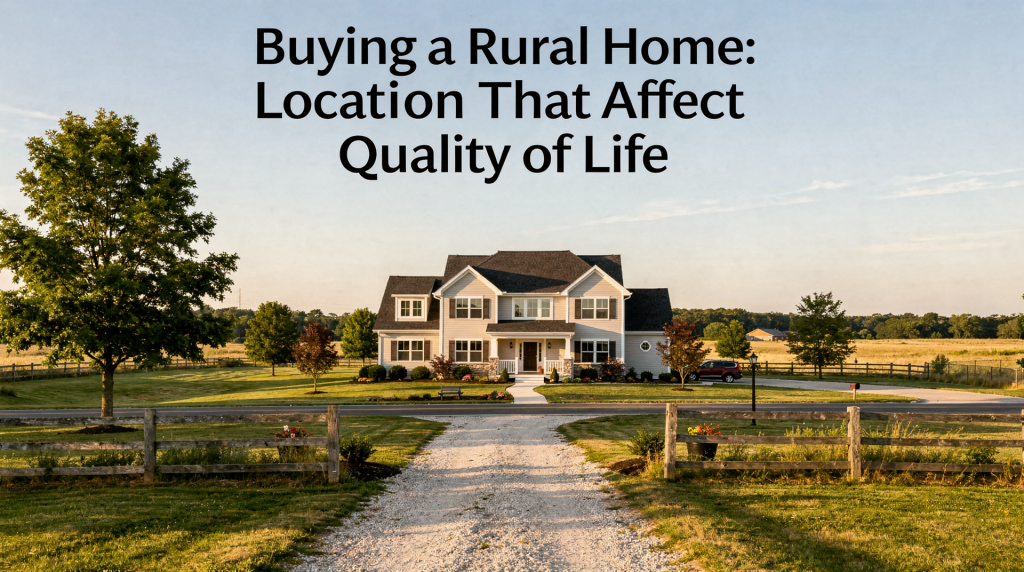
When you choose a rural home, you’re making a decision that shapes your daily stress levels, your sleep quality, and your long-term vitality — much like the food you eat or the supplements you take. The right location can turn country living into a deeply restorative experience. The wrong one can quietly drain your energy through avoidable friction: a road that washes out every spring, a commute that steals two hours of your day, or a patchy internet connection that keeps your nervous system on edge. In rural real estate, quality of life isn’t just about the view. It’s built from access, infrastructure, services, and the invisible rhythms of the land itself.
Why location matters more in rural buying
In a city, a less-than-ideal street is rarely a dealbreaker — you can walk to a café, call a ride, or switch providers with minimal disruption. In the countryside, location decisions carry far more weight because distance, road quality, utility access, and service availability directly determine how your days actually unfold. A property that looks perfect on a sunny afternoon can feel isolating or exhausting once you factor in the real logistics of living there.
Rural living often means trading convenience for space, privacy, and a deeper connection to nature. That trade-off can be profoundly health-supportive if it aligns with your lifestyle: more room to move, cleaner air, and a pace that lowers cortisol. But it becomes a source of chronic stress if you work remotely with unreliable connectivity, have school-age children who need consistent routines, require frequent medical care, or depend on regular deliveries and contractors. The key is to evaluate location not as a backdrop, but as an active participant in your wellbeing.
The rural home location factors that matter most
1. Access to roads and year-round drivability
How you reach your home each day is one of the most underrated health factors in rural living. A poorly maintained, seasonal, or privately shared road can spike your stress hormones every time you leave or return — especially during winter storms, mud season, or after heavy rain. Before falling in love with a property, trace the entire route from the main road to your doorstep and ask hard questions about maintenance, emergency access, and seasonal behavior.
Key questions to investigate:
- Is the road public or private? If private, who holds responsibility for upkeep?
- Is there a written road maintenance agreement, or is it based on informal handshakes?
- Can emergency vehicles — fire trucks, ambulances — reach the home without difficulty?
- What happens after storms, freeze-thaw cycles, or prolonged rain? Does the road become impassable?
- How long is the driveway, and what does snow removal, gravel replenishment, and culvert maintenance actually cost in time and money?
If the property sits far back from the main road, also consider whether delivery trucks, service vehicles, and guests can turn around safely. A driveway that feels charming in summer can become a liability when you need a propane delivery in February.
2. Distance to daily essentials
In rural areas, “close enough” is a deeply personal metric. A property that looks ideally situated on a map may still place groceries, gas, pharmacies, schools, or hardware stores outside a comfortable daily radius. The cumulative effect of long drives isn’t just lost time — it’s more sitting, more mental fatigue, and less opportunity for spontaneous movement or social connection.
A practical rule is to time the drive, not just measure the miles. Test the route on a weekday morning, in the evening, and during inclement weather if possible. Notice how your body feels after the trip: that low-grade tension is a signal worth heeding. The goal is a location that supports your routine without adding a layer of logistical exhaustion.
3. Healthcare and emergency response
Rural buyers often underestimate how much location shapes access to medical care — and this isn’t only about emergencies. Even if you’re in excellent health now, longer response times and farther drives matter when there’s an injury, a sick child, or a chronic condition that requires regular appointments. The stress of knowing help is far away can subtly erode your sense of safety and relaxation at home.
Before committing, verify:
- The distance and typical drive time to the nearest urgent care and hospital
- Ambulance coverage and average response times for the specific address
- Pharmacy proximity — and whether they deliver
- Specialist access if anyone in your household has ongoing needs, from endocrinology to physical therapy
Think of healthcare access as a non-negotiable layer of your wellness infrastructure, much like clean water or good air.
4. Internet and cell service
Reliable internet is no longer a luxury — it’s a determinant of how calmly you can work, learn, and stay connected. For remote workers, students, and anyone who relies on video calls or cloud-based tools, spotty connectivity becomes a daily stressor that disrupts focus and fragments your nervous system. In rural areas, advertised coverage maps often paint a rosier picture than reality.
Before buying, dig into the specifics:
- Which providers actually serve the exact address, and what technologies are available — fiber, fixed wireless, cable, DSL, or satellite?
- Are the speeds stable under real-world use, not just “up to” marketing numbers?
- Test mobile signal strength with your own phone and carrier from multiple spots on the property
- Ask about installation costs, wait times, and whether the connection can handle multiple devices simultaneously
A home that keeps you digitally tethered without friction is one that supports a calmer, more productive rhythm of life.
5. Water, septic, and utility access
Many rural homes rely on private systems rather than municipal utilities. That independence can be empowering, but it also means the location must physically support well placement, septic installation, utility connections, and proper drainage. A property can look flawless above ground and still be a poor fit if the soil won’t perc, the well water is high in contaminants, or power lines are prohibitively far from the build site.
Pay close attention to:
- Soil suitability for septic — poor drainage can lead to system failure and costly repairs
- Well water quality and quantity: test for bacteria, nitrates, heavy metals, and flow rate
- Distance to the nearest power line and the cost to bring electricity to the home
- Flooding patterns: does the land hold water after rain, and are there signs of seasonal saturation?
Water and septic aren’t glamorous, but they are foundational to your daily health. Compromised water quality or a failing septic system can create chronic stress and genuine health risks.
6. School district and childcare access
For families, rural life is woven into a full weekly routine that extends far beyond the property line. School bus routes, district boundaries, childcare availability, and drive times can shape quality of life more than acreage or scenery. A long, winding commute to school twice a day doesn’t just eat up hours — it adds mental load for parents and reduces time for play, homework, and rest.
If children are part of the picture, ask:
- Is the property on a bus route, and where is the nearest stop?
- How long is the commute in winter, when roads may be icy or unplowed?
- Are childcare and after-school options realistically accessible, or will you need to piece together a patchwork of solutions?
- How does the school calendar — early releases, snow days — interact with your work schedule?
A home that supports your family’s daily rhythm, rather than fighting it, is one that preserves energy for what matters most.
7. Noise, smells, and neighboring land use
Rural does not automatically mean quiet and pristine. Nearby farms, livestock operations, equipment use, seasonal spraying, and even hunting activity can all affect your sensory environment — and by extension, your sleep, stress levels, and ability to relax deeply. A peaceful view can coexist with early-morning tractor noise or odors that drift across property lines.
Before buying, learn what surrounds the property:
- Working farms and their typical practices (manure spreading, pesticide application, harvest schedules)
- Hunting land and seasonal firearm noise
- Gravel quarries, timber operations, or other extractive uses
- Seasonal rental properties that may bring unpredictable activity
- Agricultural traffic routes that generate dust and noise
For some buyers, the sounds and smells of working land are part of the appeal. For others, they’re a dealbreaker. The point is to go in with your eyes — and nose — wide open, recognizing that your sensory environment is a direct input to your nervous system.
8. Community feel and local support
A good rural location isn’t only about the parcel itself. It’s also about whether the area feels stable, welcoming, and practical for your needs. Social connection is a powerful determinant of long-term health, and in the countryside, community can be the difference between feeling supported and feeling stranded.
Look at:
- How well the county maintains roads, bridges, and public services
- Whether local contractors — plumbers, electricians, roofers — are available and willing to travel to your address
- Whether the area feels settled and cohesive or is changing rapidly in ways that may not align with your values
- How far you need to go for fuel, repairs, and supplies
- Whether there are gathering places, markets, or informal networks that fit your lifestyle
A location that offers both privacy and a sense of belonging is one that nourishes your social health as much as your physical surroundings.
Quick comparison: what affects quality of life most
| Factor | Why it matters | Common mistake |
|---|---|---|
| Road access | Determines daily convenience, emergency access, and whether you feel safe leaving home in any season | Assuming a scenic lane is easy year-round without checking maintenance responsibilities |
| Internet and cell service | Essential for work, school, and the mental ease of staying connected without constant buffering or dropped calls | Trusting map coverage instead of testing real-world performance at the address |
| Water and septic | Affects livability, health safety, and long-term maintenance costs | Skipping soil and system checks because the house looks move-in ready |
| Distance to services | Shapes daily commute time, stress, and how much of your life is spent in transit | Focusing only on the house and land while underestimating the cumulative toll of driving |
| Neighboring land use | Impacts quiet, smell, privacy, and resale value | Ignoring what the area is used for and assuming rural means silent |
| School and healthcare access | Matters for families and anyone with ongoing medical needs; affects daily logistics and peace of mind | Assuming “nearby town” means practical, timely access when seconds count |
How to evaluate a rural location before you buy
A simple step-by-step process
- Visit at different times of day and on a weekday to observe traffic, noise, and the true feel of the area.
- Drive the full route from the nearest town, hospital, and grocery store, noting how your body responds to the distance.
- Test cell service at the property with your own phone and carrier — walk around, go inside, check multiple spots.
- Ask who maintains the road and whether there is a written agreement; don’t settle for verbal assurances.
- Confirm water source, septic details, and utility availability, including any easements or shared infrastructure.
- Check school zones, bus routes, and childcare options if relevant, and map out the actual weekly schedule.
- Talk to neighbors about flooding, road conditions, seasonal challenges, and what they wish they’d known before moving.
- Ask local contractors whether they serve the area and how far they travel — and what their emergency response times look like.
Best questions to ask the seller or agent
- Has the road ever become impassable, and under what conditions?
- Are there any known drainage issues or areas that hold water after rain?
- Is the internet connection reliable enough for uninterrupted work from home?
- How often does the property lose power, and what backup systems are in place?
- Are there recorded easements or shared driveway arrangements that could affect privacy or access?
- What do owners here wish they had known before buying — and what would they do differently?
Common mistakes rural buyers make
Buying for the view instead of the routine
A spectacular setting can hide long-term inconvenience. If the nearest store, clinic, or school is too far for your actual lifestyle, the beauty of the land may stop mattering fast. The view doesn’t drive your kids to school or pick up a prescription. Anchor your decision in the daily rhythm you want to live, not just the panorama you want to see.
Underestimating maintenance
Rural properties often involve more self-management: driveways, septic upkeep, well testing, snow removal, drainage, and backup systems. The more remote the location, the more responsibility usually falls on the owner. This isn’t just a financial consideration — it’s a time and energy equation. If maintenance tasks crowd out the very peace you sought, the trade-off stops making sense.
Ignoring the seasons
A property that feels fine in spring can be difficult in winter or after heavy rain. Mud, ice, and isolation have a way of reshaping your relationship with a place. Always ask how the land behaves across the full year, not just on a sunny showing day. Seasonal patterns affect your mobility, your mood, and your body’s ability to recover from daily stress.
Assuming all rural roads are public
Private roads, shared lanes, and informal access arrangements can create costly surprises. Disputes over maintenance or access rights can sour the experience of home. Always confirm access rights in writing and understand exactly who is responsible for what. Clarity here protects your nervous system from ongoing low-grade conflict.
A practical quality-of-life checklist
Use this before making an offer:
- Road is legal, reliable, and maintainable year-round
- Drive time to essentials is acceptable and doesn’t create daily resentment
- Internet and cell service are verified at the address, not just promised
- Water, septic, and power are workable, affordable, and safe
- Emergency access is realistic and won’t delay critical care
- Nearby land uses match your tolerance for noise, smell, and activity
- School and healthcare access fit your household’s real needs
- Local services and contractors are available and responsive
- Seasonal weather will not trap you or cut you off from basic necessities
- The location supports the lifestyle you actually want — not the one you imagine on vacation
Final thoughts
The best rural home location isn’t the one with the prettiest land or the most dramatic view. It’s the one that makes your life easier, healthier, and more sustainable over time. When the road, services, utilities, and surrounding area align with your daily reality, rural living becomes expansive and restorative — a true foundation for wellbeing. Approach the decision with the same care you’d give to your diet or your sleep environment, because where you live is one of the most powerful health interventions you’ll ever make.
FAQ
What is the most important factor when buying a rural home?
Road access is often the most critical starting point because it affects daily convenience, emergency response, deliveries, and whether you can comfortably leave and return in all seasons. Without reliable access, even the most beautiful property becomes a source of stress.
How far is too far from town?
There is no universal number. The right distance depends on your work, family needs, medical care, school routine, and personal tolerance for driving. Timing the trip — and noticing how it affects your energy — matters more than the mileage.
Should I prioritize internet over acreage?
If you work from home, run a business, or need stable connectivity for daily life, yes. In many rural areas, reliable internet can matter more than extra land because it directly shapes your ability to earn, learn, and stay connected without chronic frustration.
What should I check first in a rural property?
Start with access, utilities, water, septic, and distance to essential services. Those basics determine whether the property is comfortable to live in or just pleasant to visit. They are the non-negotiables of a health-supportive home.
Is rural living always quieter?
No. Nearby farms, equipment, livestock, hunting, and seasonal activity can all affect noise and smells. Always assess the surrounding land use, not just the home site, and consider how the sensory environment will influence your sleep and relaxation.