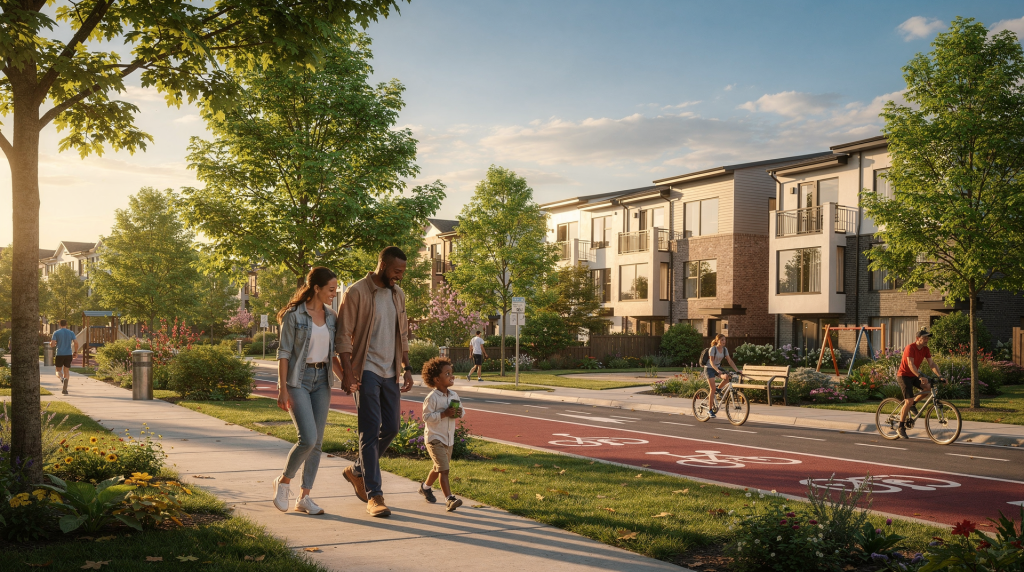
A healthier home starts with a healthier location. The best neighborhoods do more than look pleasant on a map—they reduce daily stress, support movement, improve the air you breathe, and make good habits easier to keep. If you’re comparing rural, suburban, or master-planned communities, use this checklist to judge whether a place truly supports long-term wellbeing rather than just offering a nice first impression.
Why location affects health more than most people think
Where you live shapes what you breathe, how much you move, how often you hear noise, how easy it is to get outside, and how much friction exists in daily life. Public-health frameworks for neighborhood health consistently include factors like air quality, water quality, noise, traffic, parks, housing quality, walkability, and access to destinations—all of which have a direct line to your physiology.
From a metabolic perspective, these aren’t abstract metrics. Chronic low-grade stress from noise keeps cortisol elevated, which can nudge up blood sugar and make insulin resistance harder to manage. Poor air quality triggers systemic inflammation, a known contributor to nearly every modern chronic condition. A neighborhood that forces you into a car for every errand quietly erodes the daily movement that helps maintain insulin sensitivity and cardiovascular fitness. In other words, a “good address” can still be a poor health fit if it sits beside heavy traffic, lacks sidewalks, has weak tree cover, or makes every errand require a car.
The practical checklist: what to evaluate before you buy or rent
1. Air quality
Air quality should be one of the first filters. Neighborhood health indicators often measure exposure to traffic pollution, toxic releases from nearby facilities, and proximity to hazardous sites such as Brownfields or Superfund locations. Even if you don’t have a respiratory condition, the cumulative effect of fine particulate matter can quietly undermine metabolic health over time.
Look for:
- Distance from highways, freight corridors, rail yards, and industrial zones
- Prevailing wind direction, if the area is near a source of pollution
- Tree cover and green buffer zones—they aren’t just decorative; they trap particulates
- Visible dust, smoke, or odor issues during different times of day
- Nearby permits or industrial uses that may affect outdoor air
Red flags:
- Homes backing directly onto major roads
- Constant truck traffic
- Industrial parcels within easy walking distance
- New neighborhoods built cheaply near known pollution sources
Practical tip:
- Visit the property in the morning, at rush hour, and in the evening. Air and noise patterns often change by time of day. Your lungs will notice what a quick drive-by misses.
2. Noise level
Noise is easy to underestimate during a short showing. Yet it affects sleep architecture, raises stress hormones, and can even influence cardiovascular risk over time. The body doesn’t fully adapt to chronic noise—it stays in a low-grade alert state that chips away at recovery.
Check for:
- Highway, airport, train, or arterial-road noise
- Barking dog clusters, nightlife, or construction corridors
- Outdoor noise that continues after sunset
- Sound insulation quality inside the home
Simple test:
- Stand outside for 10 minutes with no conversation and no music. Then repeat inside with windows closed. If the environment feels mentally tiring in just a few minutes, that’s a signal your nervous system will be working overtime every day.
3. Walkability and pedestrian safety
Walkability is not just a lifestyle feature. In healthy-community frameworks, it is a core indicator because it affects access to daily destinations and supports physical activity—the kind of low-intensity, consistent movement that keeps metabolism humming. A neighborhood that invites you to walk to a café, a park, or a grocery store weaves activity into your day without requiring a scheduled workout.
Good signs:
- Sidewalks on both sides of the street
- Safe crossings and slow traffic
- A connected street network—cul-de-sacs that link to paths, not dead ends
- Grocery stores, parks, schools, or cafés within a reasonable walk
- Shaded walking routes (tree canopy matters for comfort and consistency)
Poor signs:
- Dead-end streets with no pedestrian links
- Wide roads with fast traffic
- Missing sidewalks
- Routes that force you to walk through parking lots or drainage ditches
What to ask:
- Can you walk safely to a park, store, or coffee shop?
- Would a child, older adult, or stroller feel comfortable here?
- Does the neighborhood support walking as a real daily habit, or only as an occasional activity?
4. Access to nature
Nature is not a luxury feature if your goal is better health. Parks, trails, open space, and even a tree-lined street can lower stress markers, improve mood, and make movement easier to maintain. The research is clear: time in green space correlates with lower blood pressure, better heart rate variability, and reduced risk of metabolic syndrome. It’s one of the most underutilized tools for blood sugar regulation and mental clarity.
Look for:
- Parks within a short drive or walk
- Trail systems and safe access points
- Community gardens, greenbelts, or conservation land
- Mature trees and shade
- Homes with usable outdoor space—a balcony, yard, or shared courtyard that invites you outside
Best-case scenario:
- You can step outside and move without needing to plan a full outing. The threshold for a nature break should be as low as possible.
5. Water quality and drainage
Water is often overlooked until problems appear. A healthier place to live should have reliable water infrastructure and no obvious drainage issues. Beyond the obvious health risks of contaminated water, poor drainage creates a cascade of problems: mold, foundation damage, and indoor air quality issues that can aggravate allergies and respiratory conditions.
Check:
- Whether the home uses municipal or well water
- Water testing history, especially for wells—look for nitrates, bacteria, heavy metals
- Signs of flooding, poor grading, or pooling water
- Drainage systems around the home and street
- Mold, dampness, or musty smells inside
Why it matters:
- Water issues often lead to hidden costs, indoor air problems, and long-term maintenance headaches. A dry, well-drained lot is a foundational layer of a healthy home.
6. Housing quality
The neighborhood can look ideal while the home itself undermines health. Poor ventilation, old materials, and moisture problems can create avoidable stress on the body. Think of the home as a shell that either supports or works against your daily biology—air exchange, natural light, and freedom from toxins all play a role in metabolic and respiratory health.
Inspect for:
- Strong odors, mold, or past water damage
- Window quality and natural ventilation—can you flush the house with fresh air?
- Adequate sunlight—morning light in particular helps regulate circadian rhythm and sleep quality
- Non-toxic or low-emission materials where possible
- Heating and cooling efficiency—consistent temperature and humidity control matter for comfort and mold prevention
Healthy-home basics:
- Dry, well-ventilated, and well-lit spaces
- Minimal signs of pests
- No lingering chemical smell from finishes or renovations
7. Access to daily needs
A healthy place to live makes routines easier, not harder. When every grocery run, doctor’s visit, or gym session becomes a logistical event, the friction adds up. Over time, that friction can erode the consistency of health-supporting behaviors—fewer fresh meals cooked at home, skipped workouts, delayed care.
Check how far you are from:
- Grocery stores with fresh food—proximity to whole, unprocessed ingredients is a silent partner in metabolic health
- Primary care and urgent care
- Pharmacies
- Gyms, studios, or recreation centers
- Reliable internet and delivery options if the area is rural
If every task requires a long drive, the location may create more friction than it removes. The goal is a setting that makes the healthy choice the easy choice.
8. Community fit and social environment
Health is not only environmental; it is social. Neighborhood safety, neighbor behavior, and a general sense of belonging matter more than we often admit. Loneliness and social isolation have been linked to inflammation, poor sleep, and even changes in gene expression—so the social fabric of a place is a legitimate health metric.
Look for:
- Well-kept common areas—a sign of collective care
- Signs of active community life: farmers’ markets, walking groups, community gardens
- Reasonable parking and traffic behavior
- A sense that the neighborhood is cared for, not just developed
- Policies or design features that support interaction without crowding—front porches, shared green spaces, pedestrian-friendly streets
Healthy neighborhoods usually feel lived in, not merely developed. There’s a rhythm of daily life that you can sense when you spend time there.
A simple scoring table you can use
| Factor | What “good” looks like | What to avoid |
|---|---|---|
| Air quality | Away from highways and industrial sources; clean smell, good tree buffer | Constant traffic, smoke, dust, odor |
| Noise | Quiet indoors and outdoors after dark | Airports, freight routes, loud arterials |
| Walkability | Sidewalks, crossings, connected streets that lead to useful places | Car-only access, missing sidewalks |
| Nature access | Parks, trails, trees, usable outdoor space within a short walk or drive | No green space nearby |
| Water and drainage | Dry lot, no flooding signs, clean water system with test history | Pooling water, mold, bad grading |
| Housing quality | Sunlight, ventilation, solid maintenance, no dampness | Dampness, poor insulation, odors |
| Daily convenience | Grocery, care, and recreation are reachable without major friction | Every errand requires a long drive |
| Community feel | Safe, maintained, welcoming; signs of social cohesion | Neglect, clutter, frequent nuisance issues |
Step-by-step: how to evaluate a neighborhood like a local
Step 1. Visit more than once
Go in the morning, at rush hour, and after dark. One visit is not enough to understand traffic, noise, or neighbor behavior. Patterns emerge over time—the delivery truck that idles at 6 a.m., the weekend partier, the school bus route.
Step 2. Walk the area on foot
Drive-by impressions are unreliable. Walk the block, cross the streets, and notice whether people can move comfortably without a car. Pay attention to how your body feels: do you tense up near certain intersections? Is there a stretch where you instinctively speed up? Those are clues.
Step 3. Check the edges
The healthiest-looking street can still border a bad external condition. Look at what sits behind the homes, across the major road, or at the end of the neighborhood. A quiet cul-de-sac might back onto a rail line or a warehouse with early-morning operations.
Step 4. Inspect the home like it affects your daily biology
Open windows, smell for dampness, inspect ventilation, look for sunlight, and check whether rooms feel stuffy or bright. Imagine your morning routine, your sleep environment, your work-from-home setup. Does the space support or fight your wellbeing?
Step 5. Compare lifestyle fit, not just price
A slightly more expensive home may be the better value if it saves time, lowers stress, and supports better routines. Calculate the hidden costs of a poor location: longer commutes, more driving, less walking, higher stress, potential health impacts. That cheaper house can become very expensive over a decade.
Common mistakes buyers make
- Focusing on the house and ignoring the street—the granite countertops won’t compensate for a six-lane road outside the window
- Visiting only during ideal weather and daylight
- Underestimating traffic noise—it’s easy to tune out during a 15-minute showing but impossible to escape at 5 a.m.
- Assuming “rural” automatically means healthier—some rural areas have poor water quality, pesticide drift, or lack of walkable access to anything
- Confusing a quiet cul-de-sac with true walkability—it may be quiet but still trap you in a car for every errand
- Ignoring drainage, moisture, and ventilation—these are the slow burns that lead to chronic issues
- Choosing low monthly costs over long-term wellbeing—a bargain that costs you sleep, movement, and clean air is no bargain
Rural, suburban, or planned community: which tends to be healthier?
There is no perfect category. Each has trade-offs, and the right answer depends on your daily rhythm, your tolerance for driving, and what you need to feel restored.
| Type | Strengths | Risks |
|---|---|---|
| Rural | More space, less density, more nature, lower noise baseline | Long drives, limited services, poor broadband in some areas, potential water quality issues |
| Suburban | Balance of access and privacy, more amenities, often good school districts | Traffic, sprawl, weak walkability, car dependency |
| Wellness-focused community | Designed for trails, parks, and connection; often includes shared gardens, fitness amenities, and pedestrian-first design | Higher price, limited inventory, sometimes more marketing than substance |
The best choice depends on your daily rhythm. A rural home may be ideal if you value space and low noise and are willing to trade convenience for solitude. A suburban neighborhood may work better if you want access to care, schools, and errands without the intensity of a city. A wellness-oriented development can be compelling if it genuinely prioritizes sidewalks, trees, and active living rather than using those words as decoration. Look past the branding and check whether the design actually nudges you toward healthier daily patterns.
Quick checklist before you make an offer
- The street is quiet enough to relax and sleep well
- Outdoor air feels clean at different times of day
- You can walk safely to at least one useful destination
- The area has real green space, not just decorative landscaping
- The lot drains well and shows no moisture issues
- The house has good light and ventilation
- Daily necessities are realistically reachable
- The neighborhood feels stable, cared for, and livable
FAQ
Is a quieter neighborhood always healthier?
Not always. A quiet area can still have poor walkability, weak access to services, or isolation that makes daily life harder. True health-supporting quiet means low noise pollution plus the ability to engage with the world when you want to, not forced isolation.
What matters more: the house or the neighborhood?
Both matter, but the neighborhood sets your daily baseline. A great house in a poor location often creates more friction than expected—you can renovate a kitchen, but you can’t reroute a highway or plant a mature forest. Think of the neighborhood as the operating system and the house as an app; if the OS is glitchy, nothing runs smoothly.
How do I know if a neighborhood is walkable enough?
If you can safely and comfortably reach useful places on foot without dealing with fast traffic or missing sidewalks, that is a strong sign. Test it: walk to the nearest grocery, park, or café during a typical weekday. If it feels pleasant rather than like an obstacle course, the neighborhood passes.
Should I avoid homes near highways completely?
Not always, but proximity to heavy traffic is a real concern because it can affect air quality and noise exposure. Studies consistently link living near major roadways with higher rates of respiratory and cardiovascular issues. If you’re considering such a location, invest in good air filtration indoors and spend time there at peak traffic hours before deciding.
What is the fastest way to spot a healthy place to live?
Visit at different times, walk the area, and notice whether the environment makes healthy habits easy or difficult. Trust your body’s signals: if you feel more relaxed, breathe easier, and naturally want to be outside, that’s telling. If you feel on edge, closed in, or reluctant to linger, keep looking.
Conclusion
Choosing a healthier place to live is really about choosing a daily environment that reduces stress and supports better habits. The strongest neighborhoods are not just attractive—they are walkable, quieter, cleaner, better drained, easier to navigate, and closer to nature and daily necessities. They work with your biology rather than against it, making it easier to move, rest, connect, and breathe deeply.
Use the checklist above as a practical filter. If a location supports sleep, movement, clean air, and low-friction routines, it is likely supporting your health too. And just as you’d read a label before putting something in your body, read the neighborhood before putting your life there.